
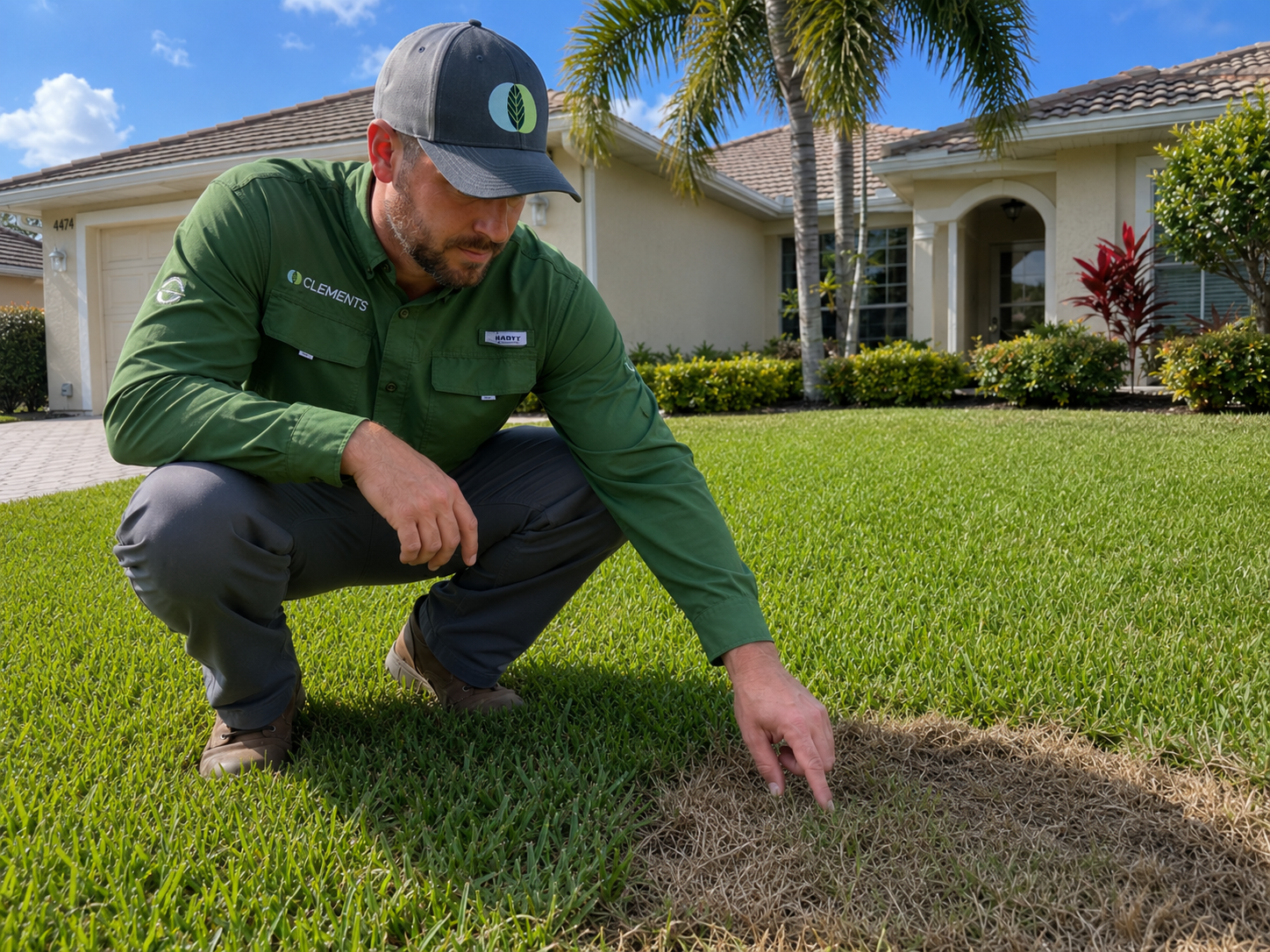
If your once-green lawn is breaking out in brown rings, irregular dead patches, or thinning spots once summer hits, you are almost certainly looking at fungus. Florida summers combine everything turf disease needs to thrive: high heat, heavy humidity, and near-daily afternoon rain. That mix turns healthy grass into an ideal host in a matter of days.
Lawn fungus is frustrating because it often looks like something else. Many homeowners mistake it for drought, overwatering, or even insect damage, and the wrong response can make the problem worse. Knowing what you are dealing with is the first step toward bringing your lawn back.
This guide covers the most common summer lawn diseases in Florida, what causes them, how to tell them apart, and the steps that actually stop the spread and help your grass recover.
Why Florida Summers Are So Hard on Lawns
Fungal spores are present in almost every lawn year round. They usually stay harmless until conditions tip in their favor, and a Florida summer tips them hard. Warm nights that stay above 65 degrees, daytime heat in the 80s and 90s, long stretches of high humidity, and frequent rain all give fungus the moisture and warmth it needs to grow and spread.
Watering habits often add to the problem. Running sprinklers in the evening, or letting an automatic system run more than the grass needs, leaves blades wet overnight. That overnight moisture is one of the biggest triggers for turf disease. Combine it with the natural rainy season and the grass rarely gets a chance to dry out.
St. Augustine grass, the dominant turf type across the Treasure Coast, Central Florida, and Southwest Florida, is especially prone to several summer diseases. Its dense growth holds humidity close to the soil, which is exactly where fungus likes to take hold.
The Most Common Summer Lawn Fungus in Florida
Most summer lawn disease in Florida comes down to a few culprits. They can look similar at a glance, but the differences matter because the cures are not the same.
Brown Patch (Large Patch)
Brown patch is caused by a soil-dwelling fungus called Rhizoctonia. It shows up as roughly circular brown or yellow patches that can grow from a few inches to several feet across, sometimes with a darker ring around the edge and greener grass in the center. It tends to flare during warm, wet stretches, and the affected blades pull away easily from the runners. Because the fungus lives in the soil, it can return to the same areas year after year if conditions are right.
Gray Leaf Spot
Gray leaf spot is a true summer disease, most active when temperatures run between the high 70s and mid 80s during the day and stay warm at night, paired with rainy, humid weather. It is caused by a fungus called Pyricularia and shows up as small brown spots on the grass blades that grow into oval, tan to gray lesions with dark brown or purple borders. In heavy cases the spots merge and whole areas of the lawn look scorched or thin. High-nitrogen fertilizer during the summer rainy season makes it noticeably worse.
Take-All Root Rot
Take-all root rot is the sneakiest of the three because the damage starts underground. The fungus attacks the roots, runners, and rhizomes, so the first thing you see above ground is yellowing and thinning that does not respond to watering or feeding. A telltale sign is that the affected grass pulls up easily and the roots and runners look dark, rotted, and short. It is commonly confused with brown patch, but the below-ground damage sets it apart. Lawns under stress from heat, compacted soil, or improper watering are the most vulnerable.
How to Tell Lawn Fungus From Other Problems
Before you treat anything, it helps to rule out the look-alikes. Drought stress, irrigation issues, fertilizer burn, and insect damage can all mimic fungus, and each one calls for a different fix.
A few clues point toward disease rather than something else:
The damage appears in rings, circles, or irregular patches rather than following sun exposure
Spots or lesions are visible on individual grass blades
The problem worsens after rainy, humid stretches
Grass stays brown or keeps spreading even with proper watering
Affected grass pulls up easily, or the runners and roots look dark and rotted
If the browning is showing up in the hottest, sunniest parts of the lawn and spreading outward, it may be an insect issue instead. Our guide on stopping chinch bug damage before it kills your lawn walks through how to spot that difference, since chinch bugs and fungus are two of the most commonly confused lawn problems in Florida.
When the cause is not obvious, an accurate diagnosis is worth far more than a guess. Treating for fungus when the real issue is insects, or the reverse, wastes time the lawn does not have.
How to Cure and Control Summer Lawn Fungus
Once you know you are dealing with fungus, the goal is to stop the spread and create conditions the disease cannot survive in. The cure is part treatment, part changing the environment that let the fungus take hold.
Fix your watering first
This is the single most important step. Water deeply but infrequently, and always early in the morning so the grass has the whole day to dry. Avoid evening and nighttime watering, which leaves blades wet for hours and feeds the fungus. During the rainy season, scale back or shut off irrigation entirely, since the rain is usually providing more than enough. Follow any local watering restrictions for your area.
Ease up on nitrogen
Heavy, quick-release nitrogen pushes lush, tender growth that fungus loves, and it makes diseases like gray leaf spot considerably worse during the summer. Hold off on high-nitrogen feeding until the weather cools and the disease pressure drops. Our look at why spring lawn fertilization matters for Florida lawns explains how to feed turf in a way that builds resilience instead of inviting problems.
Improve airflow and reduce thatch
Mow at the correct height with a sharp blade, and never remove more than a third of the blade at once. Keeping thatch in check helps the surface dry faster and removes a layer where fungus thrives. Better airflow at the soil surface is one of the simplest ways to make your lawn less hospitable to disease.
Use fungicide correctly
For active outbreaks, a fungicide can stop the spread, but timing, product choice, and proper application matter a great deal. The wrong product, or one applied too late or watered in incorrectly, often fails to help. Because brown patch, gray leaf spot, and take-all root rot respond to different approaches, correctly identifying the disease is what makes treatment work.
Preventing Lawn Fungus Before It Starts
The best cure is a lawn healthy enough to resist disease in the first place. Strong, properly maintained turf shrugs off the fungal pressure that overwhelms a stressed lawn. Consistent watering habits, smart mowing, balanced feeding, and good soil health all add up to grass that stays green through the worst of the summer.
Getting ahead of turf problems early in the season makes a real difference. The steps in our guide on how spring lawn care helps prevent pest problems before summer apply just as much to disease, because a lawn cared for properly in spring is far better equipped to handle the heat and rain ahead.
It is also worth remembering that a damaged, thinning lawn changes conditions around your home in ways that can invite other pests. We covered that chain reaction in our article on how lawn pests can become indoor pest problems, and weak, diseased turf is a common starting point. Protecting your lawn is one more way of protecting your home.
Questions Florida Homeowners Ask About Lawn Fungus
What does lawn fungus look like in Florida?
It varies by disease, but common signs include roughly circular brown or yellow patches, spots or lesions on individual grass blades, and thinning areas that keep spreading after rainy weather. If the grass pulls up easily and the roots look dark and rotted, the problem may be below the surface.
What month is lawn fungus worst in Florida?
The summer rainy season, generally June through September, is the worst stretch. That is when heat, humidity, and frequent rain combine to give fungus everything it needs. Problems often appear within days of a long wet spell.
Will my lawn recover from fungus on its own?
Sometimes, if conditions dry out and the grass is otherwise healthy. But many summer diseases keep spreading until the underlying cause is corrected, and take-all root rot in particular rarely resolves without intervention. Catching it early gives the lawn the best chance to bounce back.
Should I keep watering a lawn with fungus?
Not the way most people do. Overwatering and evening watering feed the fungus. Switch to deep, early-morning watering only, and cut back during the rainy season. Watering brown patches expecting them to green up usually makes a fungal problem worse.
Is professional treatment necessary for lawn fungus?
Not every brown spot needs a professional, but the three most common summer diseases look alike and respond to different treatments. A professional can confirm which disease you have, apply the right product at the right time, and correct the conditions that caused it, which is what protects the rest of your lawn.
How Clements Pest Control Can Help
Lawn fungus rarely fixes itself during a Florida summer. The heat and rain that trigger it stick around for months, and the wrong response can spread the problem instead of stopping it. Identifying the disease correctly and treating it the right way is the surest path back to a healthy lawn.
At Clements Pest Control, our lawn care program is built to diagnose the real cause of turf damage, treat fungal disease at its source, and strengthen your grass so it can resist future outbreaks. We help homeowners across the Treasure Coast, Central Florida, and Southwest Florida with lawn care along with pest control, termite protection, rodent control, and mosquito control, so your whole property stays protected. Whether you are in Vero Beach, Port St. Lucie, Orlando, or Naples, we know the local turf and the diseases that threaten it.
If your lawn is breaking out in brown patches, spots, or thinning areas this summer, do not wait for it to spread. Call us at 772-562-6450 or contact Clements Pest Control today to schedule a lawn inspection and get your grass back on track.