
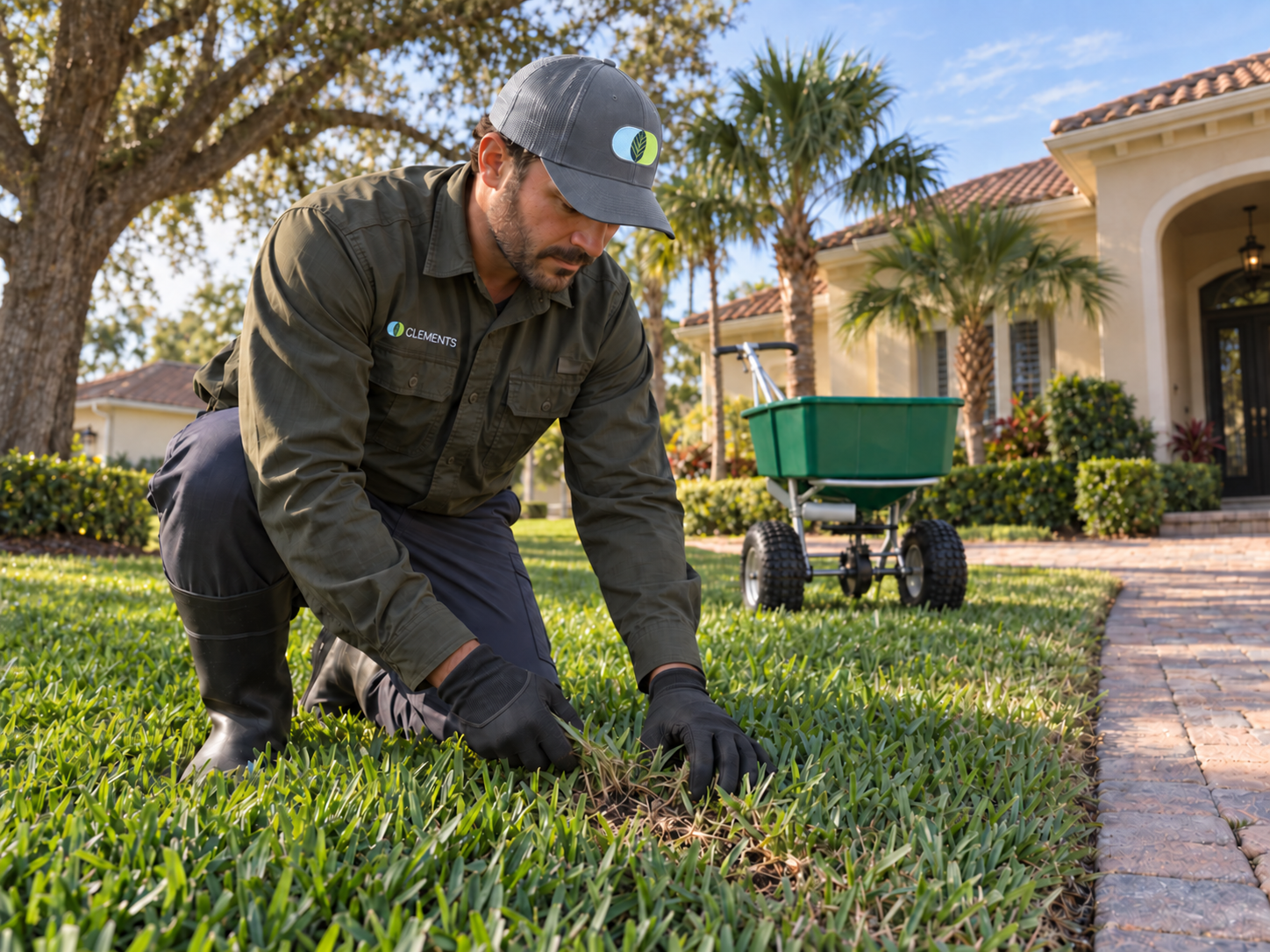
There is a moment most Florida homeowners know well. Sometime in February or March, you walk out onto the lawn barefoot and immediately regret it. Little spiny burs, dozens of them, worked down into the grass. Or the lawn is suddenly dotted with light green clumps that were not there in December and clearly are not St. Augustine.
Both of those problems may have started germinating months earlier, in the fall.
First, Which Stickers Are We Talking About?
This matters more than it sounds, because Florida homeowners use the word stickers for two completely different weeds with two completely different seasons. Treating one on the other's schedule is wasted effort.
Lawn burweed is a cool-season weed. It germinates as the weather cools in fall, grows low and flat through the winter, and forms its spiny burs as it matures in late winter and early spring. If your stickers show up around February and March, this is almost certainly what you have, and this article is about that weed.
Sandspurs, also called sandburs, are the summer version. UF/IFAS describes southern sandbur as a summer annual whose seeds begin germinating in late spring, with germination continuing through summer and fall and flowering in late fall. If your stickers are a July and August problem, you are dealing with sandspurs, and the timing in this article does not apply to them.
Same complaint, opposite calendars. The rest of this is about the winter one.
The Winter Weeds You Notice in Spring Often Began Growing Months Earlier
The weeds that make late winter miserable are what UF/IFAS calls winter annuals. They sprout when the weather cools, spend the winter growing quietly and close to the ground at a size nobody notices, and then flower and set seed as things warm back up. That flowering stage is when they finally become obvious.
By then two things are working against you. The plants are approaching the end of their natural life anyway, and they are in the process of producing seed for next year.
That is a large part of why spring weed control in Florida feels so unsatisfying. You are fighting plants that were going to finish their cycle soon regardless, at the stage when they are hardest to control and when the damage you were trying to prevent has already happened.
The Ones Florida Homeowners Notice
A few of these weeds are worth knowing by name, mostly because of how differently they behave.
Lawn burweed, the sticker weed
This is the one people call us about, and it is the best example of the whole problem.
Lawn burweed is genuinely hard to spot while it is growing. You can have a serious burweed problem in January, look at your lawn, and see nothing wrong. Then it matures and forms the spiny burs, and suddenly nobody in the house wants to walk outside without shoes and the dog is limping after being let out.
The part worth understanding is that killing the plant at that stage does not remove the burs that have already formed. They stay in the lawn until the plant material breaks down. That is why the useful work happens well before you can see the problem.
Annual bluegrass, the patchy one
Annual bluegrass is the lighter green, finer grass that shows up in clumps and looks obviously different from the rest of the lawn. It sprouts as the soil starts to cool, which in Florida means as the first real fronts start coming through.
The awkward thing about it is that it is a grass growing in a grass lawn. That makes it much harder to deal with after the fact than a broadleaf weed, because anything that kills it has to be carefully matched to the turf you want to keep.
Chickweed, henbit, and the rest
These are the softer, more ordinary looking weeds. Henbit puts out small purple flowers, chickweed forms low mats in the thinner and shadier spots. Neither one hurts the way burweed does, so people tend to live with them until they spread. The real cost is that they crowd turf that is already growing slowly in the cool season, and when they die off in spring they leave bare ground behind.
Why Late Winter Is a Much Harder Place to Start
Every year we get calls in late February asking what can be sprayed to clear out the stickers. There are still options at that point, but they are narrower and less satisfying than what was available in the fall.
Here is the distinction that matters. Preventive treatment works only on seeds that have not germinated yet, so once weeds are up, that approach is off the table. A properly selected treatment for weeds that are already growing can still help, and it works best on young, small plants. UF/IFAS makes the point that weed size matters a great deal, and seedlings are far easier to control than mature plants.
What changes the math is maturity. Once burweed has developed its sharp burs and the weeds have started producing seed, treatment gets much less useful. Killing the plant does not remove burs that already formed, and it does not undo seed that is already being produced for next year.
That is why some lawns get a little heavier every year. Each season that runs its full course helps set up the next one, and the easiest place to interrupt that is in the fall, before anything comes up.
What Has to Go Right in the Fall
Preventing winter weeds is not complicated to understand. It is just genuinely easy to get wrong, because several things have to line up at once.
The timing is tied to the weather, not the calendar. UF/IFAS ties fall weed prevention to nighttime temperatures dropping into the 55 to 60 degree range for several nights in a row. For Central and South Florida that generally means late October into early November, but it moves year to year depending on when the first fronts actually arrive. There is no date you can circle in advance.
The window is narrow in both directions. Preventive treatment works by stopping seeds before they sprout. Go too early and it is fading right when the weeds get going. Go too late and the weeds are already up, at which point prevention is no longer the tool you need. Most homeowners who try this on their own miss in one direction or the other, usually early, because national lawn advice is written for climates where fall starts in September.
One round does not cover the season. Preventive products wear off, and our cool season runs long. Protection that stops in January leaves an opening for a second wave.
Products have to match your grass. This is where do-it-yourself attempts cause real damage. Some common products are perfectly safe on St. Augustine and will badly injure bahiagrass, and some can be picked up by the roots of nearby shrubs and show up as damage on plants that were never treated. A lot of lawns we are called out to look at were hurt by the treatment, not the weeds.
It has to be watered in. These products are not doing anything sitting dry on top of the grass. They need moisture to become active, and by late October our dependable afternoon storms are finished for the year.
None of that is a secret. It is just five things that all have to be right, in a window nobody can schedule in advance, during the exact weeks your lawn looks like it needs nothing at all.
Thin Grass Is What Lets Weeds In
There is a piece of this that has nothing to do with treatment, and it matters just as much.
Weeds take hold where grass is not. In Florida, the bare spots that winter weeds move into are usually left over from summer. Chinch bug damage in the hot open strips along driveways and sidewalks. Fall armyworms, which can strip a lawn in a couple of days. Summer fungus in the low, shady, poorly draining corners.
Every one of those leaves thin turf heading into fall, and thin turf in October is an open invitation in January.
So it is worth walking your lawn and looking at it honestly. Where the grass is thick and healthy, you are protecting good turf. Where you can see soil through the canopy, you have a different problem, and no weed treatment is going to solve it. Those areas need whatever caused the damage addressed and the grass filled back in, or they are going to grow weeds every winter no matter what goes down on top of them.
Mowing height helps too, and it is free. A taller canopy shades the soil, and weed seeds that do not get light have a harder time getting started. Scalping the lawn in fall does the opposite.
Questions Florida Homeowners Ask About Winter Weeds
Why does my lawn get stickers every single year?
Because each year's plants produce seed before they finish their cycle, which reloads the soil for the following year. Unless something interrupts that, the pattern tends to repeat and often gets a little heavier each time.
My lawn looks great right now. Do I really need to think about this?
If you had stickers, patchy light green grass, or spreading weeds last spring, then yes. The seed is in the ground and simply has not sprouted yet. If last spring was clean, this is optional insurance rather than a necessity.
Can I just pull them?
On a few plants in a small area, yes, as long as you get them before they set seed. Across a whole lawn it is not realistic, because during the months when pulling would actually help, the plants are tiny, numerous, and nearly invisible.
Is it too late once I can see them?
Preventive treatment is, since that only works on seeds that have not germinated. Treatment aimed at weeds that are already growing can still help, and it works best while the plants are young and small. It becomes much less useful once burweed has formed its burs and the weeds are producing seed.
Will preventing weeds hurt my St. Augustine?
Not when the right product is used correctly on the right grass. The damage we see comes from products that were not matched to the turf, applied heavier than they should have been, or put down where new sod was going in.
Should I just use a weed and feed?
You can, but only if the timing happens to work for both jobs at once. A combination product has to match what your lawn actually needs in fertilizer and land in the right window for the weed you are targeting, and those two schedules often do not line up. When they do not, you end up feeding at the wrong time, treating at the wrong time, or both. Handling them as separate decisions is usually simpler.
What if I already missed it this year?
Then the practical plan is to manage what comes up, keep the lawn as thick as you can, and get ahead of it next fall. One prevented season makes a real difference. Two makes more.
How Clements Pest Control Can Help
Winter weed control is almost entirely a timing problem, and it is an unusually annoying one, because the right week to act is a week when your lawn looks like it needs nothing at all. Most of the weed calls we take come in late February, when the stickers are out and the honest answer is that the useful window closed months ago.
That is the kind of thing our lawn care program is meant to take off your plate. We know what these weeds are, when they tend to get going in each of our markets, and what is appropriate to use on your particular grass. We are also paying attention to the thin spots summer pests left behind, since those are where winter weeds get their start.
Clements has been taking care of Florida properties since 1961, and homeowners across Orlando and Central Florida rely on us for lawn care alongside pest control, termite protection, rodent control, and mosquito control. We also serve Vero Beach, Stuart, Port St. Lucie, and Naples.
If you would rather not track all of this yourself, call us at 772-562-6450 or contact Clements Pest Control and we will talk through what your lawn needs this season.