
There is a common way this goes wrong. A homeowner hears something overhead, goes up into the attic with a flashlight, finds droppings, sets a few traps, and catches two rats. Quiet for three weeks. Then the scratching comes back.
Nothing about that story is unusual, and the reason it repeats is simple. Traps deal with the animals that are already inside. They do nothing about the opening that let them in, and in Florida that opening is almost never somewhere you would think to look.
This post is about the openings. Not what to do once rodents are in your attic, which we covered in detail in a recent post about roof rats showing up in Florida attics in fall, but where they get in to begin with and how to close those points before the season turns.
What Cooler Nights Actually Change
Florida does not have a rodent off season. Our winters never get cold enough to shut roof rats or house mice down, so they stay active and keep breeding straight through the year. Anyone who tells you rodents "come inside when it gets cold" is describing Ohio.
What changes here in October and November is pressure and behavior. Landscaping finished its biggest growth spurt of the year during the summer rains, so branches and fronds that cleared the roof in May are often touching it now. Outdoor food sources shift as fruit finishes, which sends rodents out exploring. Homeowners open the windows and shut off the AC, so overhead noise that was always there suddenly carries. And an insulated attic on a 62 degree night is genuinely more appealing than it was in August.
The practical takeaway is that fall is not when rodents arrive. It is the last good window to close the house up before a small problem becomes an established one.
Know Which Rodent You Are Dealing With
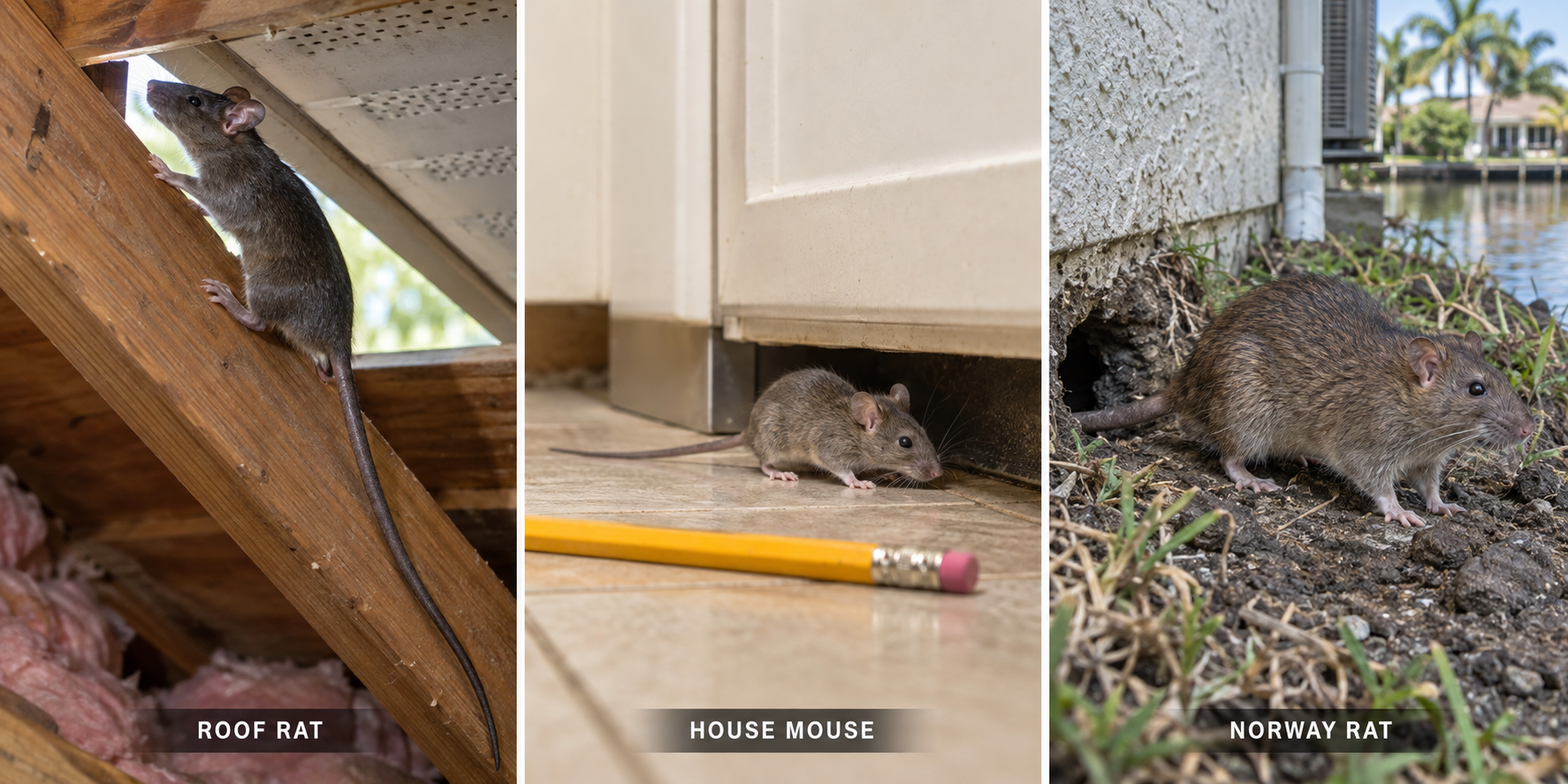
This matters more than people expect, because the three rodents common in Florida homes enter at different heights through different sized openings.
Roof rats
The dominant rodent in Vero Beach homes by a wide margin, and also called palm rats, fruit rats, or black rats. They are excellent climbers, they nest high, and they need an opening about half an inch wide to get through. Adults run half a pound to a pound, and the tail is longer than the head and body combined. Droppings are up to half an inch long with pointed ends.
Roof rats breed fast. UF/IFAS puts them at six to eight young per litter and up to six litters a year, with sexual maturity at three to five months. A pair in October is a real population by spring.
House mice
Smaller, grayer, and far easier to overlook. A mouse weighs about half an ounce and its droppings are only about an eighth of an inch, rod shaped, easy to mistake for dirt. The number that matters: a house mouse can get through a gap about a quarter inch wide, roughly the width of a pencil. That means an opening you would never consider a hole is a door.
Mice also breed faster than rats. They reach breeding age in about six weeks and can produce up to eight litters a year. They tend to live inside walls, under cabinets, and behind appliances rather than in the attic, so the signs show up in the kitchen and pantry instead of overhead.
Norway rats
Much less common in Florida homes but not absent, particularly near canals, dumpsters, and commercial areas. They are heavier and browner, with a shorter and thicker tail, and they burrow at ground level rather than climb. Their droppings are larger, closer to three quarters of an inch, with blunt ends. If you are finding burrows along a foundation or under a shed, this is the more likely culprit.
The Walkaround: Where Rodents Actually Get In
Here is the useful exercise. Walk your house from the roof down, looking specifically for openings rather than for animals. Most homeowners have never done this, and most find something.
Roof line and above
This is where roof rats do their business, and it is the hardest area to inspect from the ground.
Soffit seams and returns. The joint where a soffit panel meets the fascia, and the corner where the soffit wraps a gable, are the single most common roof rat entries on Florida homes. Vinyl soffit in particular pulls loose over time.
Roof and attic vents. Turbine vents, static vents, and ridge vents often have screening that has rusted, torn, or was never installed.
Gable vents. On older Vero Beach homes these are frequently louvered wood with no screen at all behind them.
Tile roof edges. If you have barrel tile, the open tile ends at the eave and the ridge create voids. From under the tile it is a short trip to a soffit seam.
Plumbing stacks and vent boots. The rubber boot around a plumbing vent pipe cracks in Florida sun, and the gap that opens up is exactly rat sized.
Where a roof meets a second story wall. This junction is frequently open behind the flashing and almost never inspected.
Chimney. Uncapped or with a rusted cap.
Mid wall level
Easy to overlook because nobody thinks of a wall as having holes in it. It has several.
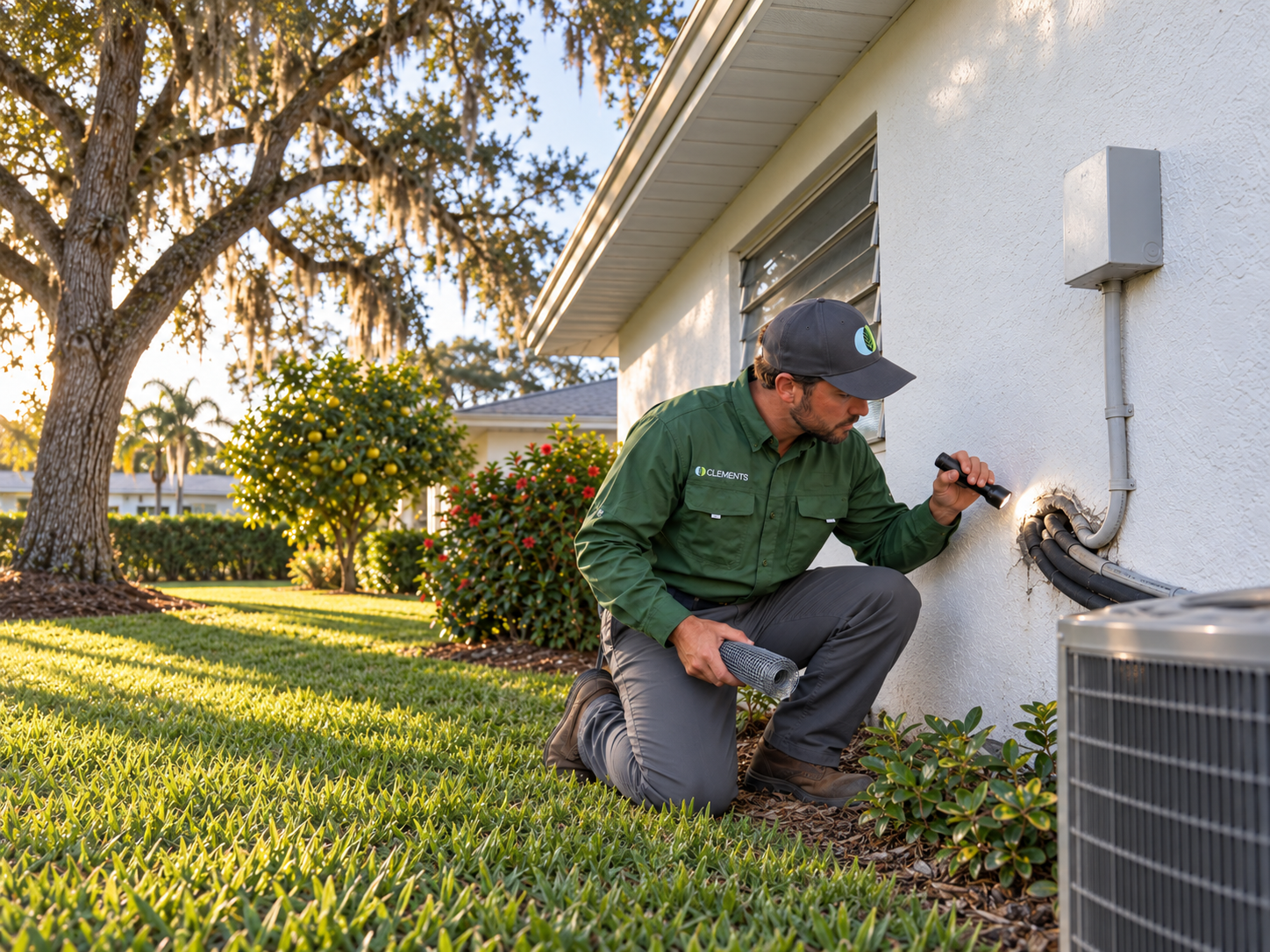
AC line set penetration. Where the refrigerant lines enter the wall, the original sealant has usually dried out and pulled away. This is one of the most reliable openings on any Florida home.
Dryer vent. The exterior flap often will not close fully, or the damper is missing entirely.
Weep holes. On block and brick construction these are intentional and should stay open for drainage, but they are large enough for a mouse. Stainless weep hole covers solve this without blocking drainage.
Hose bibs, cable, electrical, and gas penetrations. Each is a drilled hole, and each was sealed once with a material that has had a decade of sun on it.
Window and door frames. Gaps at the corners of frames, and missing weather stripping.
Ground level
Garage door corners. The bottom corners where the door meets the track are the classic gap. A garage door can look perfectly sealed across the bottom and still have a quarter inch triangle at each corner.
Garage door bottom seal. Rubber seals crack, flatten, and stop making contact on uneven slabs.
Garage side door thresholds. Same problem, smaller scale.
Screen enclosures and pool cages. Not an entry into the house itself, but a torn screen at a kick plate creates a protected zone right against the wall where rodents can work unseen.
Crawl space vents. Relevant on older barrier island cottages built on piers rather than slab.
Slab and foundation cracks, and utility trenches where a line was run under the slab.
Pet doors. Worth mentioning because they are a door.
Why Indian River County Homes Give Rodents an Edge
A few things about this area specifically make the walkaround worth doing.
Citrus country. Indian River County is built on citrus, and roof rats are drawn to fruit above almost anything else. A backyard grapefruit or orange tree, or a grove edge near a neighborhood, provides a steady food source. Fruit left on the ground is an open invitation, and where there is food nearby, rodents look for a nest site nearby.
Older construction. A lot of Vero Beach housing stock dates to the 1950s through the 1970s. Concrete block homes from that era commonly have unscreened gable vents, original wood fascia that has softened, and penetrations sealed with materials that gave up years ago.
Barrier island cottages. Older wood frame homes near the beach, some raised on piers, add crawl space vents and under floor access to the list.
Mature oak canopy. The live oaks that make the older neighborhoods around Vero Beach and Sebastian so pleasant also put limbs over rooflines. A roof rat does not need a branch to touch the roof, only to get within jumping distance.
Lagoon and canal edges. Water is never far, which removes one of the few limits on rodent populations.
None of this is a reason to cut down your oaks. It is a reason to look at the connection points between the landscape and the structure.
Sealing It So It Holds
The material matters as much as finding the gap.
What works:
Quarter inch hardware cloth for vents and larger openings
Sheet metal or metal flashing for structural gaps
Copper mesh or steel wool packed into small openings, then sealed over with caulk or mortar
Mortar or concrete patch at foundation and slab gaps
Proper vent covers with intact damper flaps
New garage door bottom seal and corner seals
What does not:
Expanding foam by itself. Rodents chew through it easily. It is a filler, not a barrier. Foam over metal mesh is fine. Foam alone is a temporary patch that looks finished.
Standard window screen. Fiberglass insect screening is not rodent screening.
Caulk alone on anything larger than a small crack.
Duct tape or plastic sheeting. These last one season at most.
One important warning: if you have evidence that rodents are already inside, sealing the exterior first can trap animals in your walls and attic. That ends with dead rodents in inaccessible spaces and a smell that lasts weeks. The correct order is inspection, then trapping and removal, then sealing, then confirmation. Sealing an empty house is prevention. Sealing an occupied house is a mistake.
A Fall Walkaround Worth Twenty Minutes
Before the season turns, take a lap around the outside of the house with a flashlight and check:
Branches and palm fronds within a few feet of the roof line
Soffit seams and gable corners, looking for separation or dark greasy smudging
Roof vents, gable vents, and the plumbing vent boot
The AC line set penetration and the dryer vent flap
All four corners of the garage door and the condition of the bottom seal
Weep holes and any drilled penetration for cable, gas, or a hose bib
Fruit on the ground and pet food or birdseed stored in the garage
Mulch piled against the foundation and dense shrubs touching the walls
Then go inside and check the pantry and the cabinet under the kitchen sink for eighth inch droppings, which is where mouse activity shows up first.
Questions Treasure Coast Homeowners Ask
How small a gap do rodents really need?
A house mouse can get through about a quarter inch, roughly the width of a pencil. A roof rat needs about half an inch. Both numbers are smaller than what most people picture, which is why gaps that seem too minor to bother with are usually the ones being used.
Does spray foam keep rodents out?
Not on its own. Rodents chew through expanding foam without much trouble. Use it as a sealant over a physical barrier such as hardware cloth, copper mesh, or sheet metal, never as the barrier itself.
Where do rodents get into Florida homes most often?
On our service calls, the recurring points are soffit seams and gable corners, unscreened or damaged roof and gable vents, the AC line set penetration, and the bottom corners of the garage door. If you only check four things, check those.
Should I seal everything up right now if I think something is already in my attic?
No. Have it inspected first. Sealing a house with an active population inside traps the animals in your walls and attic, which creates a worse and smellier problem. Removal comes before exclusion.
I have never seen a rodent inside. Is this still worth doing?
Yes, and it is far cheaper than the alternative. Sealing entry points on a house with no current activity is straightforward preventive work. The same job after an established population has been chewing wiring and contaminating insulation is a much bigger project.
Does mulch against the house matter?
It does. Deep mulch piled against the foundation gives rodents cover to work along the wall unseen and holds moisture that attracts other pests. Keeping mulch a few inches off the foundation and shrubs trimmed back from the walls removes that protection.
Is fall too late to start?
No. Fall is the right time. Because Florida rodents are active year round, the goal is not to beat a migration, it is to close the house before the population near your property finds its way in and settles for the season.
How Clements Pest Control Can Help
Finding the gaps is the hard part. A soffit seam that has separated a quarter inch, a vent boot that cracked over the summer, a corner of the garage door that no longer touches the slab, none of those announce themselves from the driveway, and they are the difference between a house that stays sealed and one that keeps getting reinfested.
At Clements, rodent work starts with a full exterior and attic inspection to find how they are getting in, followed by removal of anything already inside, exclusion with materials that actually hold, and follow up to confirm the activity has stopped. We have served Florida homeowners since 1961, and families across Vero Beach and the Treasure Coast rely on us for rodent control alongside pest control, termite protection, mosquito control, and lawn care. We also serve Stuart, Orlando, and Naples.
If you would rather have someone look at the roof line and the penetrations properly before the season sets in, call us at 1-844-606-BUGS or contact Clements Pest Control to schedule an inspection.