
You walk out to the lanai in the morning and there is a web stretched corner to corner across the screen, with a spider in the middle of it the size of your palm, legs included. It was not there yesterday.
The instinct is to get something to spray it with. Before you do, it is worth knowing what you are looking at, because in Florida the odds are overwhelming that the spider making you nervous is harmless and is doing you a favor.
Florida has hundreds of spider species. Two groups have venom that matters medically to people, and one of those two does not actually live here. That leaves a very short list to worry about, and a very long list that deserves to be left alone.
Why Fall Feels Like Spider Season
Unlike some of the seasonal pest stories in Florida, this one is real rather than a trick of perception.
Most of the big web builders you notice in September and October hatched in the spring. They spent the warm months eating and growing, and autumn is simply when they reach full adult size. The golden silk orbweaver strung across your pool cage was there in June. She was the size of a grain of rice and her web was four inches across, so nobody noticed her.
Two other things line up at the same time. Adult males stop building webs and start wandering to find females, which is why you suddenly see spiders crossing the garage floor and the pool deck. And the summer rainy season produced an enormous crop of flying insects, so there is more food available than at any other point in the year, which supports more and larger spiders.
Put together, fall is the one time of year when Florida spiders are genuinely at their most visible. It passes.
Start With the Myth: Florida Does Not Have Brown Recluse Spiders
This is worth clearing up first, because more Florida homeowners believe they have seen a brown recluse than have seen almost any other spider, and the belief drives a lot of unnecessary worry.
According to UF/IFAS, no breeding population of any recluse spider has ever been found in a natural habitat in any Florida county. There are roughly 20 verified specimens on record for the entire state, and every one of them was found inside a building or a vehicle. They arrived as hitchhikers in cargo and in the belongings of people moving here from the Midwest and Mid-Atlantic, where the spider actually does live.
So what are people finding?
The southern house spider
Almost always, it is a male southern house spider. He is light brown, roughly the right size, has long legs, and turns up in exactly the places people expect a recluse: garages, sheds, block walls, and the corners of eaves. Females are darker, velvety brown, and build the thick messy webs you see in the mortar joints of block construction.
The southern house spider is harmless. It is also extremely common along the Treasure Coast.
The tell is the eyes
If you ever need to settle it, count eyes. Recluse spiders have six eyes arranged in three pairs. Southern house spiders, like most spiders, have eight. A phone camera with the zoom pushed in will show you this clearly enough on a photo, and you do not need to get close to the spider to take one.
A related note worth making: many so called spider bites diagnosed in Florida are not spider bites at all. Bacterial skin infections, in particular, are frequently attributed to a recluse that was never there.
The Short List: Widow Spiders
Widows are the only spiders in Florida with venom that is medically significant to people. Florida has four species: the brown widow, the southern black widow, the northern black widow, and the red widow.
All of them are shy. None of them are aggressive. Widows do not chase, they do not defend their webs, and bites happen almost exclusively when the spider is pressed against skin, typically by a hand reaching into a dark space or by clothing or a glove that was left outside.
Brown widow
This is the widow you are most likely to encounter around a Florida home, and it is now the most commonly found widow across much of the state.
Color is a poor way to identify it, because brown widows range from light tan to nearly black with variable markings. Two features are reliable:
The hourglass is orange to yellow orange, not red.
The egg sac is covered in pointed projections. It looks tufted or spiky, like a small pale globe with spines. No other widow makes an egg sac like this, and it is the single easiest way to confirm what you have.
Where they turn up: mailboxes, the underside of patio chairs and table rims, the recessed corners of door frames and entryways, garbage can handles and lids, the inside lip of planters, and the track and corner brackets of screen enclosures. All of these are places a hand goes without looking.
One detail that sounds worse than it is: brown widow venom is roughly twice as potent as black widow venom drop for drop. In practice the brown widow delivers far less of it, is smaller, and is extremely reluctant to bite, so brown widow bites are generally much milder than black widow bites.
Southern black widow
The one everyone pictures. A glossy black spider with a complete red hourglass on the underside of the abdomen, females running about an inch and a half to two inches across including the legs.
They favor low, dark, undisturbed places: garages, sheds, outbuildings, under the rim of a grill cabinet, in stacked pots and lumber, boat and trailer storage, and inside things that sat outside untouched. Shoes and boxes left in a garage are a classic.
Red widow and northern black widow
Both are uncommon around homes. The red widow is a Florida endemic that lives in sand pine scrub habitat in the central part of the state and almost never encounters people. The northern black widow shows up occasionally. Neither is likely to be what is on your lanai.
What a widow bite actually involves
Worth knowing plainly, because the reality sits between "harmless" and the way it gets described online.
A black widow bite can produce headache, muscle pain, elevated blood pressure, and abdominal cramping that can be severe. It is genuinely unpleasant and warrants medical attention. With treatment, people typically recover within about 24 hours, and without supportive care it generally runs three to five days.
Deaths are rare enough to be notable. In one year of national data covering more than 2,100 reported cases, there were no deaths at all. Children, older adults, and anyone with existing health concerns should be seen promptly, and anyone bitten should get medical advice, but this is a treatable situation rather than an emergency in the way movies suggest.
The Ones That Look Alarming and Are Not
This is most of them, and several are worth actively wanting around.
Golden silk orbweaver. The big one on your pool cage. Females are large with long banded legs, and the web has a distinctly golden cast in the sun. Also called banana spiders locally. They are not aggressive, their bite is medically insignificant, and a single adult female eats a remarkable volume of flying insects, mosquitoes included.
Spiny-backed orbweaver. The small white or yellow crab shaped one with six colorful spines, strung on a web across a walkway at face height. Florida homeowners walk into these constantly. Completely harmless and a dedicated mosquito eater.
Yellow garden spider, or writing spider. Large, boldly striped black and yellow, with a heavy zigzag of white silk down the middle of the web. Harmless and one of the most effective insect predators in a Florida yard.
Huntsman spider. Large, flat, fast, brown, and usually encountered on a wall at night, where it startles people badly. It does not build a web. It is not medically significant and it eats roaches, which is a trade most people would take.
Wolf spiders. Stout, brown, ground hunting, often seen crossing a garage floor or patio. Females carry their egg sac attached to the spinnerets and later carry the spiderlings on their back, which is why one sometimes appears to be covered in texture. Harmless.
Jumping spiders. Small, compact, with big forward facing eyes, and they turn to look at you. The regal jumping spider is common here and is about as close as a spider gets to charming. Harmless.
Cellar spiders. The long legged ones in garage corners and under the house. The old line about them having the most powerful venom of any spider but fangs too short to use is simply false. Their venom does not do anything to people.
Green lynx spider. Bright green with spiny legs, sits on shrubs and flowers. Harmless, and a heavy predator of garden pests.
The general rule holds up well: if it built a neat circular web out in the open, it is almost certainly harmless. Widows build messy, irregular, tangled webs in dark low places, not tidy orbs in the open air.
Why the Treasure Coast Sees So Many
A few local factors stack up here.
Screened enclosures. Pool cages and screened lanais are close to ideal spider habitat. The frame gives anchor points, the screen catches and concentrates flying insects, and the structure offers shelter from wind and rain. Homes around Stuart, Palm City, Sewall's Point, and Hobe Sound have these in high numbers, which is why the lanai is where most spider conversations start.
Outdoor lighting. Exterior lights pull in enormous numbers of flying insects after dark, and spiders build where the food is. The heaviest webs on most houses are within a few feet of a light fixture, and that is not a coincidence.
Preserve and water edges. Martin County neighborhoods back up to the Savannas, Atlantic Ridge, the St. Lucie River, and a dense network of canals. That proximity means a steady supply of insects and a steady supply of spiders.
Humidity and a long warm season. Spiders here get a much longer active period and far more generations than they would further north.
Boats, trailers, and storage. Covered boats, stored trailers, and garage shelving on the Treasure Coast create exactly the dark undisturbed spaces black widows prefer. Worth remembering before reaching under a cover.
What Actually Reduces Spiders Around the House
Spraying everything is the common instinct and the least effective approach, because spiders are there in response to the insects, not the other way around.
Go after the food supply. Reducing flying insect pressure around the home does more to reduce spider populations than treating for spiders directly. This is where mosquito control and general pest management around the structure do real work.
Change your outdoor lighting. Switching exterior bulbs to warm LED or yellow bug lights, and moving light sources away from doors where practical, reduces the insect concentration that draws spiders in.
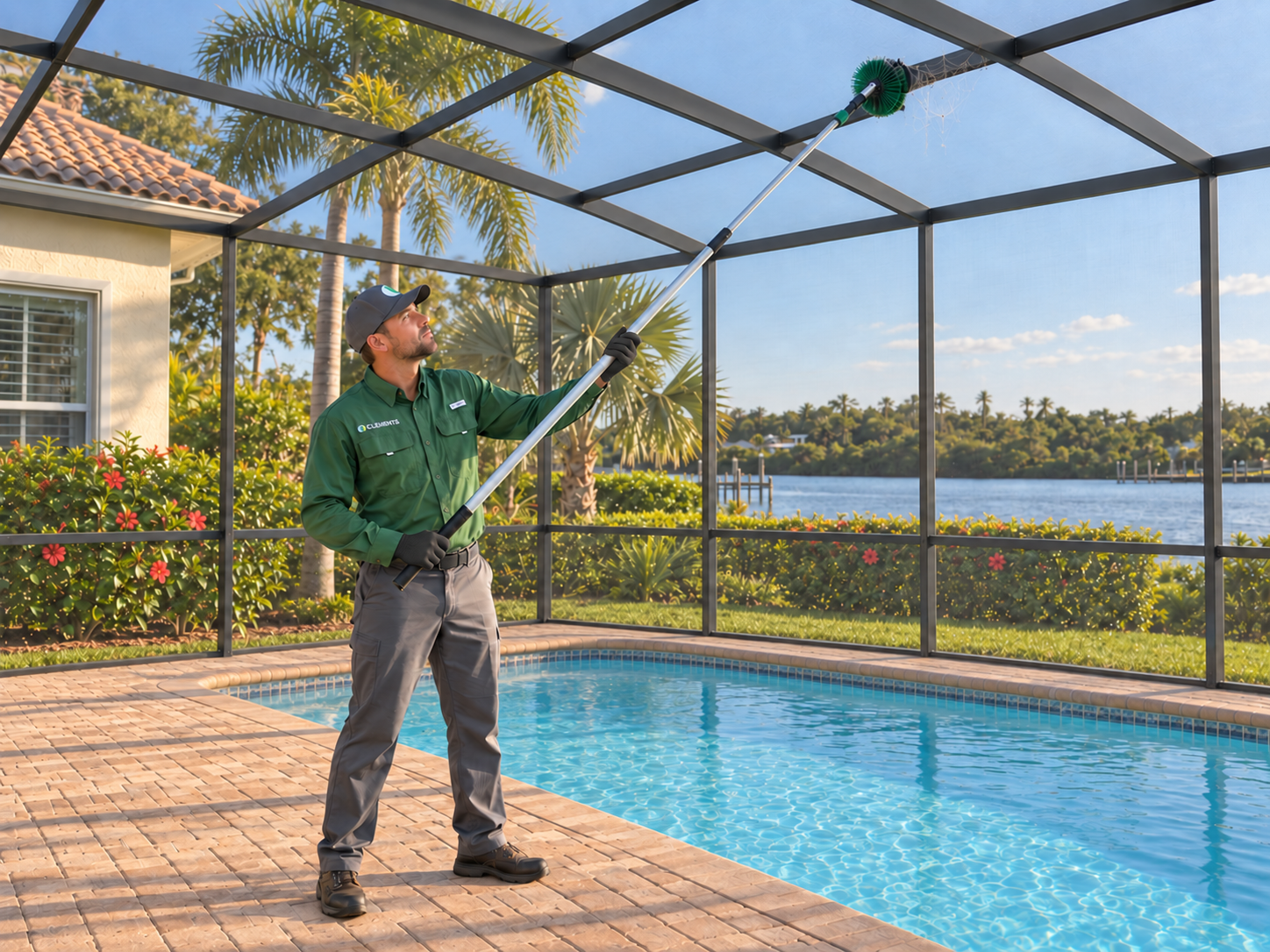
Knock webs down regularly. A web broom or a hose on the eaves, soffits, light fixtures, door frames, and the corners of the pool cage every few weeks discourages rebuilding. It is tedious and it works better than almost anything else a homeowner can do.
Reduce harborage. Move firewood, lumber, and stacked pots away from the house. Clear leaf litter against the foundation. Keep the garage organized enough that boxes are not sitting undisturbed for years.
Wear gloves, and shake things out. Almost every widow bite comes from a hand meeting a spider in a dark space. Gloves for yard work, a look before reaching under patio furniture or into a mailbox, and a shake of anything that has been sitting outside.
Seal the gaps. The same soffit seams, door sweeps, and wall penetrations that let rodents and other pests inside are how spiders get in too.
Leave the orbweavers where they are not in the way. A golden silk orbweaver on a corner of the pool cage is eating mosquitoes every night. If she is not across a doorway, she has earned her spot.
Questions Treasure Coast Homeowners Ask About Spiders
Are there brown recluse spiders in Florida?
Not as an established population. UF/IFAS reports no breeding population of any recluse spider found in natural habitat in any Florida county, with only about 20 verified specimens statewide, all found inside buildings or vehicles after arriving from elsewhere. What people find is nearly always a male southern house spider, which is harmless.
How do I tell a brown widow from an ordinary brown spider?
Look for the egg sac. A brown widow egg sac is covered in pointed projections and looks spiky or tufted, and nothing else makes one like it. If you can see the underside of the spider, a brown widow has an orange to yellow orange hourglass rather than a red one.
Is the big spider on my pool screen dangerous?
Almost certainly not. The large spiders on screen enclosures are usually golden silk orbweavers or other orbweavers, which are not aggressive and not medically significant. Neat circular webs out in the open are a reliable sign of a harmless spider. Widows build messy tangled webs in dark, low, sheltered places instead.
What should I do if I think a spider bit me?
Clean the area, apply a cold compress, and watch it. If you develop muscle pain, cramping, severe abdominal pain, or symptoms beyond local irritation, seek medical care and mention the possibility of a widow bite. If you can safely photograph the spider, that helps. Keep in mind that many suspected spider bites turn out to be something else entirely, often a bacterial skin infection.
Are daddy long legs really the most venomous spider?
No. This is one of the most durable pieces of misinformation about spiders. Cellar spiders pose no risk to people, and the claim about their venom has no basis.
Should I kill the spiders I find outside?
Around the outside of the house, generally no. Orbweavers, jumping spiders, lynx spiders, and wolf spiders are meaningful predators of mosquitoes, flies, and other pests, and removing them tends to make the insect situation worse rather than better. Widows in high contact areas like a mailbox, a door frame corner, or under patio furniture are a different matter and should be removed.
Why did all these webs appear at once?
Because the spiders finished growing. Most large web builders hatched in spring and reached full size by early fall, so the webs got big at roughly the same time across the whole neighborhood. Adult males also begin wandering in search of mates this time of year, which is why you see more spiders on the move.
Does a regular pest control service help with spiders?
Indirectly, and that is actually the point. A program that reduces the insect population around the structure removes what spiders are there for, and consistent web removal and treatment of eaves, soffits, and enclosure frames keeps them from re-establishing in high traffic areas.
How Clements Pest Control Can Help
Most of the spiders around a Florida home are harmless, and a good deal of spider management is knowing which ones to leave alone. The parts worth handling are the widows in places where hands go, the webs that keep coming back on the lanai and around the doors, and the insect pressure that is bringing spiders to the house in the first place.
At Clements, spider work is part of regular pest service rather than a one time spray: inspection of the eaves, soffits, door frames, and screen enclosure for widow activity, web removal in the areas that matter, treatment where it is warranted, and attention to the flying insect population that supports the whole thing. Families around Stuart and the Treasure Coast have counted on us since 1961 for pest control, termite protection, rodent control, mosquito control, and lawn care. We also serve Vero Beach, Orlando, and Naples.
If you have found a widow near a door or you are tired of clearing the same webs off the pool cage every week, call us at 1-844-606-BUGS or contact Clements Pest Control and we will take a look.