
It usually starts the same way. You are sitting in the living room after dinner and you hear something moving above the ceiling. Not a thump, more like a light scratching that stops when you stand up and starts again a few minutes later. You tell yourself it is the AC, or a branch on the roof, or the house cooling down.
By the second or third night, you stop telling yourself that.
Roof rats are the most common rodent in Naples homes and across Southwest Florida, and every fall we get a wave of calls from homeowners hearing exactly that. Here is the part most people find surprising: the rats were almost certainly there before fall. What changes in October and November is not the rat population. It is your odds of noticing.
Roof Rats Do Not Have an Off Season Here
In colder states, rodent control has a clear seasonal story. Temperatures drop, mice and rats look for warmth, and they push indoors. Southwest Florida does not work that way. Our winters are mild enough that roof rats stay active and keep breeding all year, so they are not fleeing the cold when they end up in your attic. They are just doing what they always do, which is looking for a dry, quiet, elevated place to nest.
So why does fall feel like roof rat season in Naples?
The landscaping just had its biggest growth spurt of the year. From June through September, the rainy season pushes shrubs, vines, palms, and tree limbs hard. Branches that were comfortably clear of the roof in May are often resting on the eaves by September, and a roof rat only needs one to reach the roof line.
Seasonal residents come home and start listening. A house that sat quiet all summer suddenly has people in it at night. Homeowners head into the attic for storage or holiday decorations and see droppings for the first time. The activity did not begin in October, the attention did.
Windows and doors open up. Once the humidity breaks, people turn off the AC and open the house. A quieter home with less background noise makes overhead scratching much easier to hear.
Outdoor food shifts. Roof rats are fond of fruit, and as fall progresses the easy pickings around the yard change. That pushes them to explore, and exploring is when they find the gap at your soffit.
Cooler nights make a warm attic more appealing. It is a nudge rather than the dramatic push it is up north, but a 65 degree night does make an insulated attic a more attractive place to nest.
Put together, fall is when an existing problem becomes an obvious one. That is actually good news, because a roof rat problem you catch in October is far smaller than the same problem in February.
Why Naples Homes Are Easy for a Climbing Rat
Roof rats earned the nickname palm rats for a reason. They are excellent climbers, and almost everything that makes a Naples property attractive to live on also makes it easy for a rat to get up high.
Barrel tile roofs. Tile is a beautiful roof and a rough one to seal. The natural gaps at the eave line, the open ends of the tiles along the ridge, and the spaces where tile meets flashing all create voids that a rat can work with. Once under the tile, it is only a short distance to a soffit seam or a vent.
Palms. Coconut palms, queen palms, and areca clusters are ideal rat habitat on their own. The dead frond boots and dense crowns give rats a nesting spot and cover, and a palm planted close to the house is a direct ladder to the roof.
Ficus and dense hedges. The tall privacy hedges common throughout Naples and Southwest Florida communities give rats a protected highway from yard to yard and often lead right up against the structure.
Mature, established landscaping. The gated communities and older neighborhoods around Naples have landscaping that has been growing for decades. It looks wonderful and it provides continuous cover from the preserve or canal edge all the way to your foundation.
Fruit trees. Mango, avocado, citrus, and loquat are strong attractants. Fallen fruit left on the ground is a reliable food source, and a rat with steady food nearby will look for a nest site nearby too.
Water everywhere. Canals, lakes, retention ponds, and the preserve edges that make our neighborhoods pleasant also mean rats never have to go far for water.
None of this means you have to tear out your landscaping. It means the connection points between your yard and your roof deserve attention.
How to Tell It Is Roof Rats
Not every noise overhead is a rat, and the difference matters because the treatment does.
A roof rat is slender and gray to nearly black, running roughly 13 to 18 inches from nose to tail tip. The giveaway is the tail: on a roof rat it is hairless and longer than the head and body combined. Norway rats, which are much less common in Florida homes, are heavier and browner with a shorter, thicker tail, and they tend to burrow at ground level rather than climb.
Droppings are the most reliable evidence. Roof rat droppings are about half an inch long with pointed ends, and you will typically find them in clusters along attic framing, on top of insulation, in the garage, or on the shelf of an outdoor grill cabinet. Norway rat droppings are noticeably larger, closer to three quarters of an inch, with blunt ends.
Timing of the noise tells you a lot. Roof rats are mostly active at night, so scratching and scurrying that starts around dusk and quiets by morning points to rats. Daytime activity overhead, especially with heavier thumping and no noise at night, is more likely squirrels.
Rub marks and runways. Rats travel the same paths and leave greasy, dark smudges along beams, trusses, pipes, and the tops of walls. Those smudge trails are one of the most useful things to look for with a flashlight, because they show you where the animals are moving.
Other signs to look for this fall:
Gnaw marks on wiring, PVC, AC line insulation, or wood framing
Insulation that looks tunneled through, compressed, or hollowed into a nest
Shredded paper, fabric, or insulation gathered into a ball
A musky odor in the attic or near the AC air handler
Chewed or hollowed fruit on the ground under your trees
Droppings in the garage, especially near stored pet food or birdseed
Dark smudges around a soffit seam, roof vent, or plumbing stack
Why This Is Not Just a Noise Problem
It is tempting to live with a little scratching, especially if the attic is out of sight. There are a few reasons not to.
Rats gnaw constantly, and attic wiring is a favorite target. Chewed insulation on a live wire is a real fire risk, and it is the single most expensive potential consequence of leaving a roof rat population alone. They also chew AC ducts and drain lines, which quietly wrecks your cooling efficiency, and they compress and contaminate insulation, which does the same.
They contaminate as they go, leaving droppings and urine across insulation, stored belongings, and anything else in the attic. Rats can carry disease and bring parasites like fleas and mites in with them.
And they multiply fast. Gestation is only about three weeks, litters run five to eight pups, and a single female can produce dozens of offspring in a year. A pair in September is a serious problem by spring. That math is the real argument for handling it now rather than after the holidays.
What Actually Gets Roof Rats Out
Effective roof rat work has an order to it, and skipping the first step is why so many do-it-yourself efforts fail.
Exclusion comes first
You cannot trap your way out of a building that is still open. Rats can squeeze through a gap as small as half an inch, so the work is finding and sealing every one of those openings: soffit seams, gaps at the eave and ridge on a tile roof, roof and attic vents, plumbing and utility penetrations, gable vents, and where the roof line meets a second story wall. Vents should be screened with hardware cloth rather than window screen, which rats chew through easily.
This is detailed work on a Florida tile roof, and it is the part that determines whether the problem stays fixed.
Then remove the animals already inside
Once the building is closed, the rats inside need to be trapped and removed. Trapping is generally the right tool in an attic because it lets you confirm what you caught and how many, and because it avoids the risk of an animal dying somewhere inaccessible. It also takes follow-up visits to know the activity has actually stopped, which is why a single trap set once rarely resolves anything.
Take away the ladders and the cover
Trim branches and palm fronds back several feet from the roof line and keep them there. Thin dense hedges away from the walls. Pick up fallen fruit. Store pet food and birdseed in sealed containers, ideally indoors. Keep the garage door seal in good shape. This is the maintenance that keeps a sealed home from becoming a target again.
Skip the things that do not work
Ultrasonic repellers do not clear an attic. Poison scattered in an attic without exclusion creates dead animals in wall voids and does nothing about the entry point, so a new group moves into the same opening. Peppermint oil and similar deterrents may make you feel better about the situation but will not move an established nest.
Questions Naples Homeowners Ask About Roof Rats
Why am I hearing rats in my attic now when I never did before?
Most likely because the population found your roof over the summer while the landscaping grew into it, and you are only now in a position to hear them. Roof rats are active year round in Southwest Florida, so fall is less about new arrivals than about new awareness. Cooler nights, open windows, less AC noise, and returning seasonal residents all raise the odds you notice.
Are roof rats and palm rats the same thing?
Yes. Palm rat is the local nickname for the roof rat, earned because they nest so readily in palm crowns and dead frond boots. You may also hear them called black rats or fruit rats. Same animal.
Can roof rats really get in through a half inch gap?
They can. That is why a visual once-over from the driveway is not enough and why exclusion work on a tile roof takes time. The openings that matter are often the ones you would never think to look at, like the seam where a soffit panel meets the fascia or the gap under a barrel tile at the eave.
How do I know if it is rats or squirrels in my attic?
Listen to the clock. Squirrels are active during daylight and tend to make heavier, more purposeful thumping. Roof rats are mostly nocturnal, so scratching that begins around dusk and settles down by dawn points to rats. Droppings help too, since squirrel droppings are more rounded and roof rat droppings are about half an inch with pointed ends.
Will they leave on their own once it cools off?
No. That is a northern assumption that does not apply here. Southwest Florida stays warm enough that roof rats have no reason to leave a good nest site, and an attic that has already been colonized will keep getting used until the entry points are sealed and the animals are removed.
Is trapping or bait better for roof rats in an attic?
For rats already in an attic, trapping is generally the better approach because it confirms results and avoids animals dying in inaccessible spaces. Exterior rodent management can play a role in reducing pressure around the structure, but neither approach substitutes for sealing the openings. Exclusion is what keeps the next group out.
How long does it take to solve a roof rat problem?
Expect a process rather than a single visit. Inspection and exclusion first, then trapping and removal, then follow-up visits to confirm activity has stopped. Depending on how many entry points a home has and how established the population is, that generally runs a few weeks.
How Clements Pest Control Can Help
Roof rats are one of those problems where the difference between a fix and a temporary quiet spell comes down to how thoroughly the building was sealed. Anyone can set a trap. Finding every half inch gap along a barrel tile roof line, screening the vents properly, and then confirming the activity has actually stopped is the work that keeps them out for good.
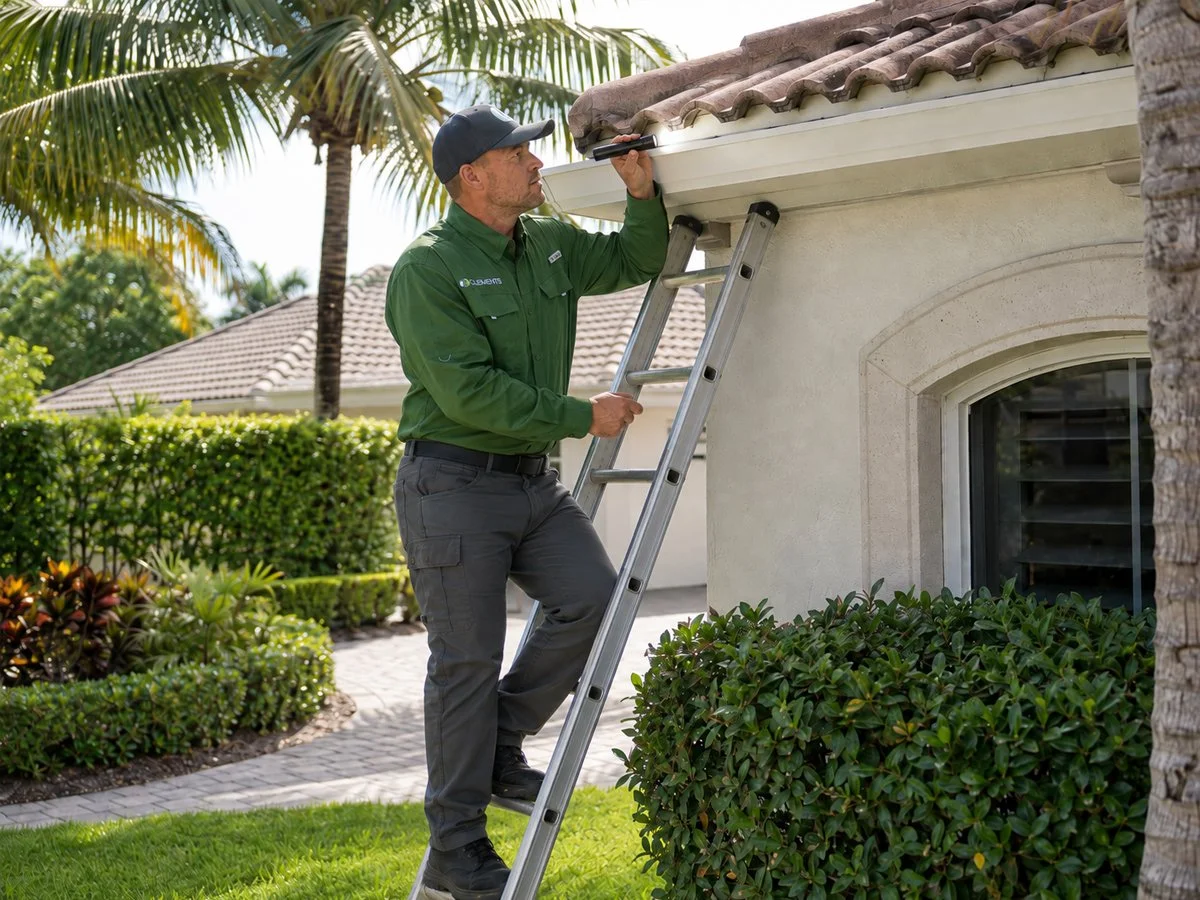
At Clements Pest Control, we handle roof rats the way Southwest Florida homes require: a full inspection of the roof line, soffits, and attic to find how they are getting in, exclusion work to close those points, removal of the animals inside, and follow-up to confirm it is resolved. Homeowners across Naples and Southwest Florida count on us for rodent control alongside pest control, termite protection, mosquito control, and lawn care, so the whole property stays protected. We also serve the Treasure Coast and Central Florida, including Vero Beach, Stuart, and Orlando.
If you are hearing something in the attic after dark, the smartest thing you can do is have it looked at now rather than after the holidays. Call us at 772-562-6450 or contact Clements Pest Control to schedule an inspection.