
Florida's warm weather keeps stinging insects active for most of the year, and by the time summer arrives, wasps and hornets are busy building nests around homes, patios, and yards. To many homeowners, every black-and-yellow flyer looks the same. But paper wasps, yellowjackets, mud daubers, and hornets are different insects with different habits, and telling them apart can help you decide how worried you actually need to be.
This guide walks through the wasps and hornets you are most likely to run into around Florida homes, how to recognize each one, and the practical steps that keep you and your family safe. If you have already been keeping an eye on seasonal bugs, you may have read our look at why pest activity increases as Florida warms up. Stinging insects follow that same warm-weather pattern.
Wasps vs. Hornets: What's the Difference?
People use the words "wasp" and "hornet" interchangeably, but there is a real distinction. Hornets are actually a specific type of wasp. All hornets are wasps, but not all wasps are hornets.
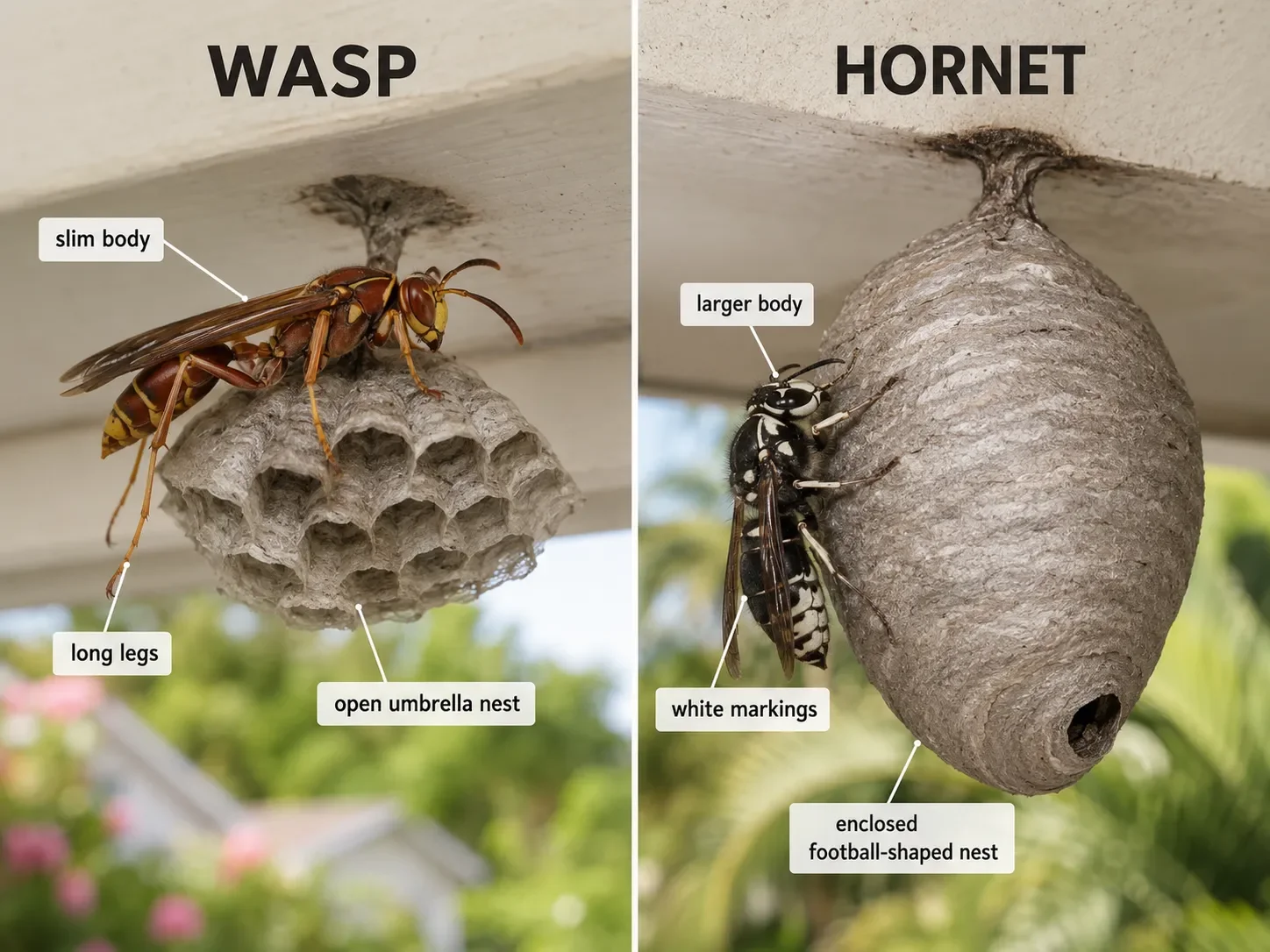
In general, hornets are larger and build big enclosed nests, while many wasps are slimmer and build smaller, open nests. Here is something that surprises a lot of Florida homeowners: the only true hornet living in the state is the European hornet. The well-known bald-faced hornet, despite its name, is technically a type of yellowjacket.
What matters most for your home is behavior. Some of these insects are mild-mannered and rarely sting, while others defend their nests aggressively. Knowing which is which is the whole point of learning to identify them.
Common Wasps in Florida
Paper Wasps
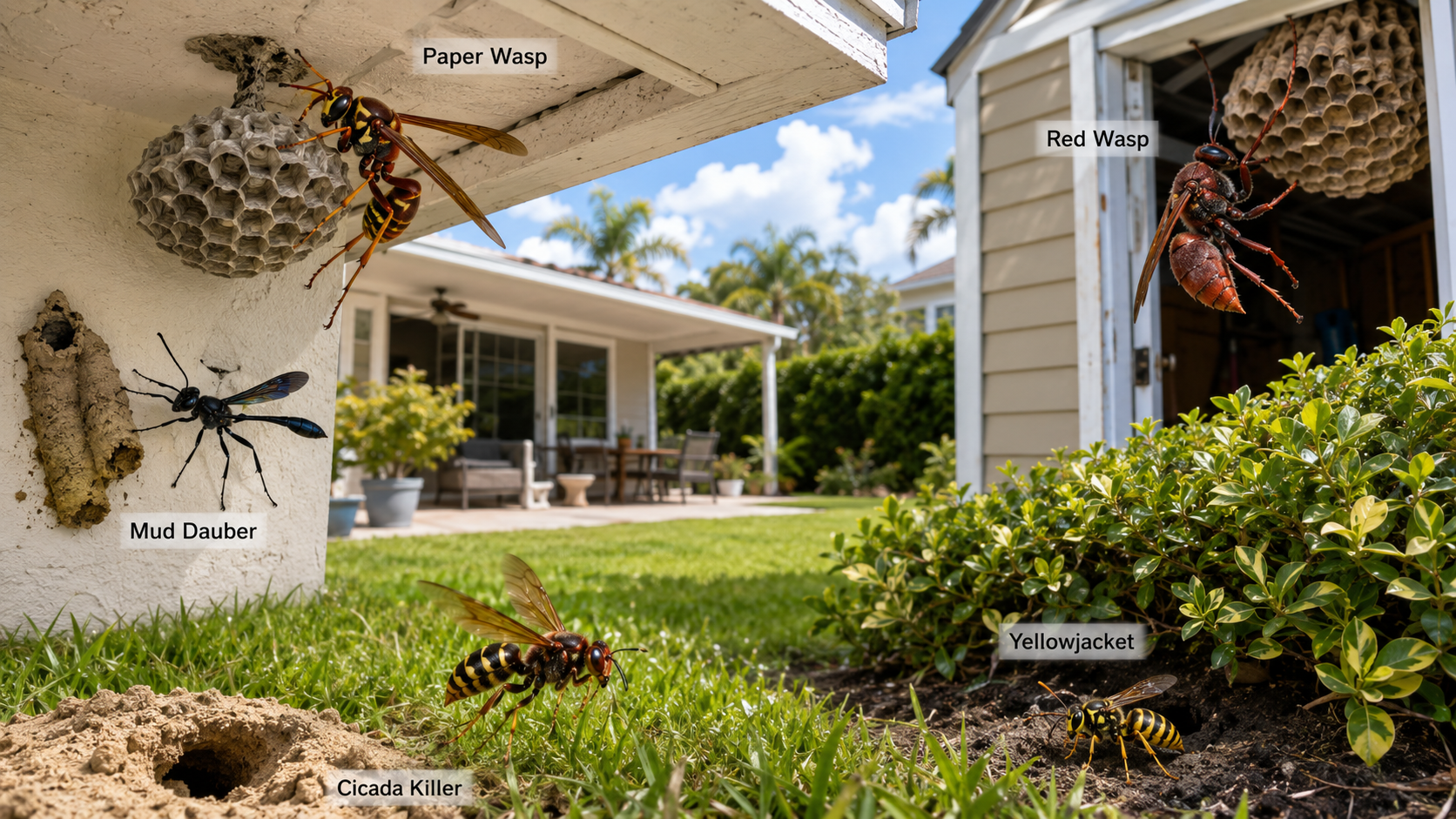
Paper wasps are probably the species you see most often around Florida porches and eaves. They have slim bodies, long legs that dangle as they fly, and coloring that ranges from reddish-brown to dark brown with yellow markings. Most are about three-quarters of an inch to an inch long.
Their nests are easy to recognize. A paper wasp nest looks like a small gray umbrella made of papery material, with open cells visible underneath. You will usually find them hanging from eaves, porch ceilings, door frames, and patio covers.
Paper wasps are not especially aggressive and often ignore people who leave them alone. The trouble starts when a nest is built right next to a door, a grill, or a high-traffic area where someone is likely to disturb it by accident.
Red Wasps
Red wasps are a type of paper wasp, but they are worth calling out on their own because Floridians see them so often. They are reddish-brown to dark red, slightly larger and bolder than the lighter paper wasps, and they build the same open, umbrella-shaped nests in sheltered spots.
Red wasps tend to be more defensive than lighter-colored paper wasps, and their sting is memorable. If you find a reddish nest tucked under an eave or inside a shed, it is best to keep your distance.
Yellowjackets
Yellowjackets are some of the most troublesome stinging insects in Florida. They have bright yellow and black patterning, with horizontal yellow bands across the abdomen, and they are shorter and stockier than paper wasps.
The bigger concern is where they nest. Yellowjackets build large, enclosed paper nests that are often hidden underground, inside wall voids, in attic spaces, or tucked into shrubs and rock piles. Because the nest is concealed, homeowners frequently stumble onto one without warning, often while mowing the lawn or doing yard work.
Yellowjackets are aggressive when their nest is threatened, and unlike honeybees, a single yellowjacket can sting repeatedly. A hidden ground nest is one of the more dangerous stinging-insect situations you can run into in a Florida yard.
Mud Daubers
Mud daubers are the gentle giants of the group. These slender, often black or metallic blue wasps have a long, thin "waist" and build distinctive nests out of mud. You will spot their tube-shaped or lumpy mud nests on walls, under eaves, inside sheds, and in other protected spots.
The good news is that mud daubers are solitary and rarely sting. They are not defensive the way paper wasps and yellowjackets are, and they actually help control spiders, which they hunt to feed their young. Many homeowners simply scrape off the old mud nests once the wasps have moved on.
Cicada Killers
Cicada killers look alarming because of their size. These large wasps can reach an inch and a half long, with reddish-brown bodies and yellow markings, and they are often mistaken for hornets. They dig burrows in sandy or loose soil, which is common across much of Florida, and you may see them flying low over a lawn in mid to late summer.
Despite their intimidating appearance, cicada killers are generally not aggressive toward people. The males may hover and act territorial, but they cannot sting, and the females rarely do unless handled. Their burrowing can leave small mounds of dirt in the lawn, which is usually the bigger nuisance for homeowners.
Hornets in Florida
European Hornets
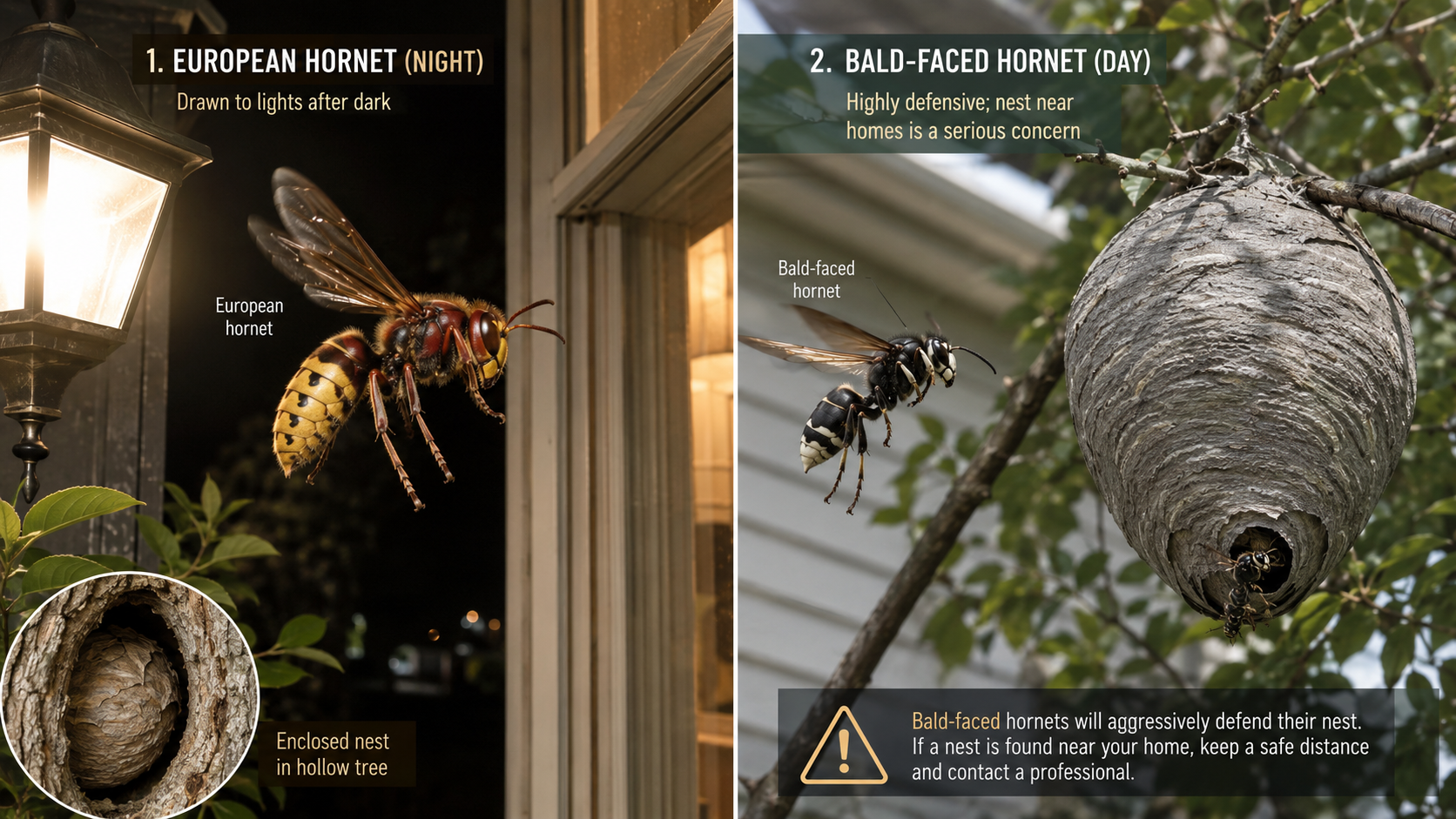
The European hornet is the only true hornet found in Florida. It is a large insect, ranging from about three-quarters of an inch to nearly an inch and a half long, with a reddish-brown thorax and a yellow abdomen marked with distinctive teardrop-shaped spots.
European hornets are unusual because they are active at night and are often drawn to lights, which can lead to startling encounters near porches and windows after dark. They build enclosed nests in hollow trees, wall voids, and attics. They are not quick to sting, but like other large stinging insects, they will defend their nest if it is disturbed.
Bald-Faced Hornets
The bald-faced hornet is technically a yellowjacket, but most people know it as a hornet because of its size and its dramatic nest. It has a black body with creamy-white markings on the face and at the tip of the abdomen, which makes it fairly easy to identify.
Its nest is the real giveaway. Bald-faced hornets build large, gray, football-shaped or teardrop-shaped paper nests that hang from trees, shrubs, eaves, and the sides of buildings. These nests can grow surprisingly large by late summer.
Bald-faced hornets are highly defensive and will aggressively protect their nest, sometimes pursuing a perceived threat for a distance. A bald-faced hornet nest near your home is one situation where it really is safer to call a professional than to attempt removal yourself.
How to Tell Them Apart at a Glance
When you spot a stinging insect or a nest, a few quick questions usually narrow it down:
Is the nest an open gray umbrella under an eave? That points to paper wasps or red wasps.
Did the insects come out of the ground or a wall void? Yellowjackets are the usual suspects.
Is there a large, enclosed gray football-shaped nest hanging in a tree or on the house? That is most likely a bald-faced hornet.
Do you see tube-shaped mud nests on a wall? Those belong to harmless mud daubers.
Is a large wasp hovering low over the lawn or digging in sandy soil? That is probably a cicada killer.
Is a big reddish-brown hornet showing up at night around lights? That suggests a European hornet.
Why Wasps and Hornets Are So Active in Florida
Florida's climate is close to ideal for stinging insects. Mild winters, long warm seasons, and steady humidity let colonies start early in spring and keep growing well into fall. Nests that might stay small in cooler states can reach full size here, especially by mid to late summer.
Yards also offer everything these insects need. Flowering plants and shrubs provide nectar, other insects provide food for their young, and the eaves, soffits, sheds, and dense landscaping around homes provide sheltered nesting spots. This is the same warm-weather pattern that pushes outdoor pests toward your home as the seasons change, and it shows up across the Treasure Coast, Central Florida, and Southwest Florida alike.
Practical Tips for Florida Homeowners
A few simple habits make your property less inviting to wasps and hornets:
Inspect early and often. Walk your eaves, soffits, porch ceilings, sheds, and fence lines in spring and early summer, when nests are small and easier to deal with.
Seal entry points. Close gaps around soffits, vents, and wall openings so yellowjackets and hornets cannot nest inside voids.
Keep food and drinks covered outdoors. Yellowjackets in particular are drawn to sugary drinks, fruit, and protein at cookouts.
Manage trash and recycling. Keep lids tight and rinse containers, since food residue attracts foraging wasps.
Trim back dense landscaping. Overgrown shrubs and trees give wasps and hornets protected places to build.
Do not swat at a single wasp. Quick movements can provoke a sting, especially near a nest you have not noticed yet.
When to Call a Professional
A single mud dauber or a tiny new paper wasp nest in an out-of-the-way spot may not need any action at all. But some situations are best left to trained technicians, including:
A large or enclosed nest, such as a bald-faced hornet or yellowjacket nest
A nest in the ground, a wall void, an attic, or any hidden space
A nest near a doorway, walkway, grill, or play area
Any nest if you or a family member has a known sting allergy
Disturbing the wrong nest can trigger dozens of stings in seconds. With aggressive species like yellowjackets and bald-faced hornets, professional removal is the safer choice.
Frequently Asked Questions
What is the most dangerous wasp in Florida?
Yellowjackets cause the most problems for Florida homeowners. Their nests are often hidden underground or in wall voids, they defend them aggressively, and a single yellowjacket can sting many times. Bald-faced hornets are also highly defensive around their large hanging nests.
Are there real hornets in Florida?
Yes, but only one. The European hornet is the only true hornet in the state. The bald-faced hornet, despite its name, is actually a type of yellowjacket.
What does a wasp nest tell me about which species I have?
Quite a lot. Open, umbrella-shaped gray nests under eaves usually mean paper wasps. Large enclosed football-shaped nests in trees or on walls point to bald-faced hornets. Hidden underground or in-wall nests usually mean yellowjackets. Tube-shaped mud nests belong to harmless mud daubers.
Will wasps and hornets go away on their own?
Most colonies die off by late fall or winter, and the old nest is usually not reused. The problem is that an active nest in spring and summer keeps growing and becomes more dangerous over time, so waiting it out is rarely the safest option near a home.
Is it safe to remove a wasp nest myself?
A very small, newly started nest in an open area may be manageable, but anything large, enclosed, hidden, or near a high-traffic area is best handled by a professional. This is especially true for yellowjackets and bald-faced hornets, which can swarm and sting repeatedly.
How Clements Pest Control Can Help
Wasps and hornets are part of life in Florida, but a growing nest near your front door, patio, or play area is not something you should have to live with. At Clements Pest Control, our technicians safely terminate stinging insects and remove the nests, so you can use your yard and outdoor spaces without worrying about an unexpected swarm.
Stinging insects are also rarely the only pest pressure a Florida home faces. We help homeowners across the Treasure Coast, Stuart and the Port St. Lucie area, Central Florida, and Southwest Florida with year-round pest control, termite protection, rodent control, mosquito control, and lawn care.
If you have spotted a nest or you are seeing more wasps and hornets around your property than usual, contact Clements Pest Control to schedule an inspection. We will identify what you are dealing with and handle it safely.