
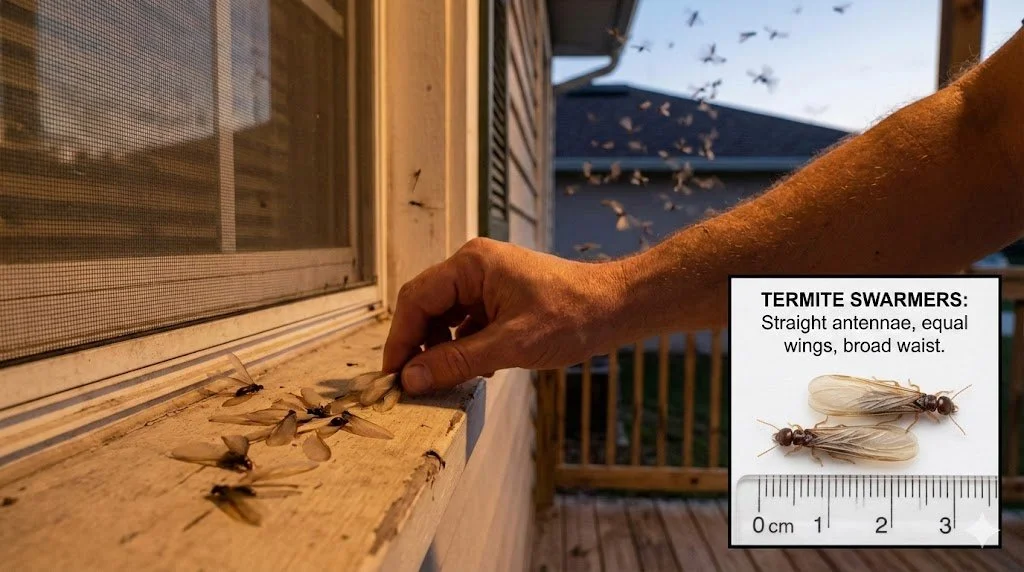
What Termite Swarmers Mean (And Why You Shouldn't Ignore Them)
You're sitting on your porch on a warm spring evening when you notice a cloud of winged insects swirling near your roofline. Maybe you sweep a few off the windowsill and think nothing of it. But if those insects are termite swarmers, that moment deserves a lot more attention than a broom and a shrug.
Termite swarmers are one of the clearest warning signs nature gives you that a termite colony is nearby — or already inside your home. Here's what they are, what they mean, and why acting fast makes all the difference.
What Are Termite Swarmers, Exactly?
Termite swarmers (also called alates) are the reproductive members of a termite colony. Their job is simple: fly out, find a mate, and start a new colony. They're not the ones doing the wood damage — that's the workers — but their presence tells you something important: a mature, established colony is close by.
Swarmers are often mistaken for flying ants, so it's worth knowing the difference. Termite swarmers have:
Straight antennae (ants have elbowed antennae)
Two pairs of equal-length wings (ants have mismatched wing sizes)
A broad, straight waist (ants have a pinched waist)
When Do Termite Swarmers Appear?
In Florida, swarming season typically kicks off in late winter and runs through spring and early summer — though subterranean termites can swarm on warm days nearly year-round in our climate. Swarms are often triggered by warm temperatures following a rain event, and they usually happen during the day.
The swarm itself doesn't last long — typically just 30 to 40 minutes. After that, the swarmers shed their wings, and you may find piles of discarded wings near windowsills, door frames, or light fixtures. Those wing piles are just as significant a clue as seeing the swarm itself.
Does Seeing Swarmers Mean My Home Is Infested?
Not necessarily — but it's a red flag you can't afford to ignore. Here's why:
If swarmers are coming from inside your home, that's a strong indicator that a colony has already established itself somewhere in your structure. Walls, crawl spaces, wood framing — termites can be active for years before you ever see visible damage.
If swarmers are outside near your home, it means a colony is nearby and potentially scouting your property as a future food source. Subterranean termites travel through the soil, so "nearby" can mean they're already closer than you think.
Either scenario warrants a professional inspection. The absence of visible damage doesn't mean the all-clear — termites do most of their work hidden from view.
Why You Shouldn't Wait It Out
Termites cause an estimated $5 billion in property damage in the United States every year, and most homeowner's insurance policies don't cover it. By the time you notice warped floors, hollow-sounding walls, or buckling paint, the damage is often already extensive.
The tricky part is that a swarming event can feel like it's over once the insects disappear. But the colony — and the destruction — doesn't go anywhere. Swarmers are just the visible tip of the iceberg.
Getting ahead of a termite problem is almost always cheaper and easier than dealing with it after the damage has been done.
What to Do If You See Termite Swarmers
Don't panic, but don't ignore it. A swarm is a signal, not a sentence. Catching it early gives you options.
Note where you saw them. Were they coming from inside or outside? Near a specific wall, window, or wood structure? This helps the inspector narrow things down.
Collect a few samples if you can. A small bag with a few insects — or even just the shed wings — helps confirm the species.
Schedule a professional inspection as soon as possible. A trained eye can spot signs of termite activity that aren't obvious to homeowners, including mud tubes, frass, and subtle structural changes.
Florida Homeowners: The Risk Is Higher Than You Think
Florida's warm, humid climate makes it one of the most termite-prone states in the country. Subterranean termites in particular thrive here, and because they live and travel underground, they can invade a home with almost no outward warning signs until a swarm appears. If you want to understand more about the specific species you're up against in our region, this guide on subterranean termites in Florida is a great place to start.
If you've seen swarmers — or even just the wings they left behind — don't wait. Contact us at Clements Pest Control for a thorough inspection. We serve homeowners across Florida and know exactly what to look for in our local environment. Catching a termite problem early is the best investment you can make in protecting your home.