
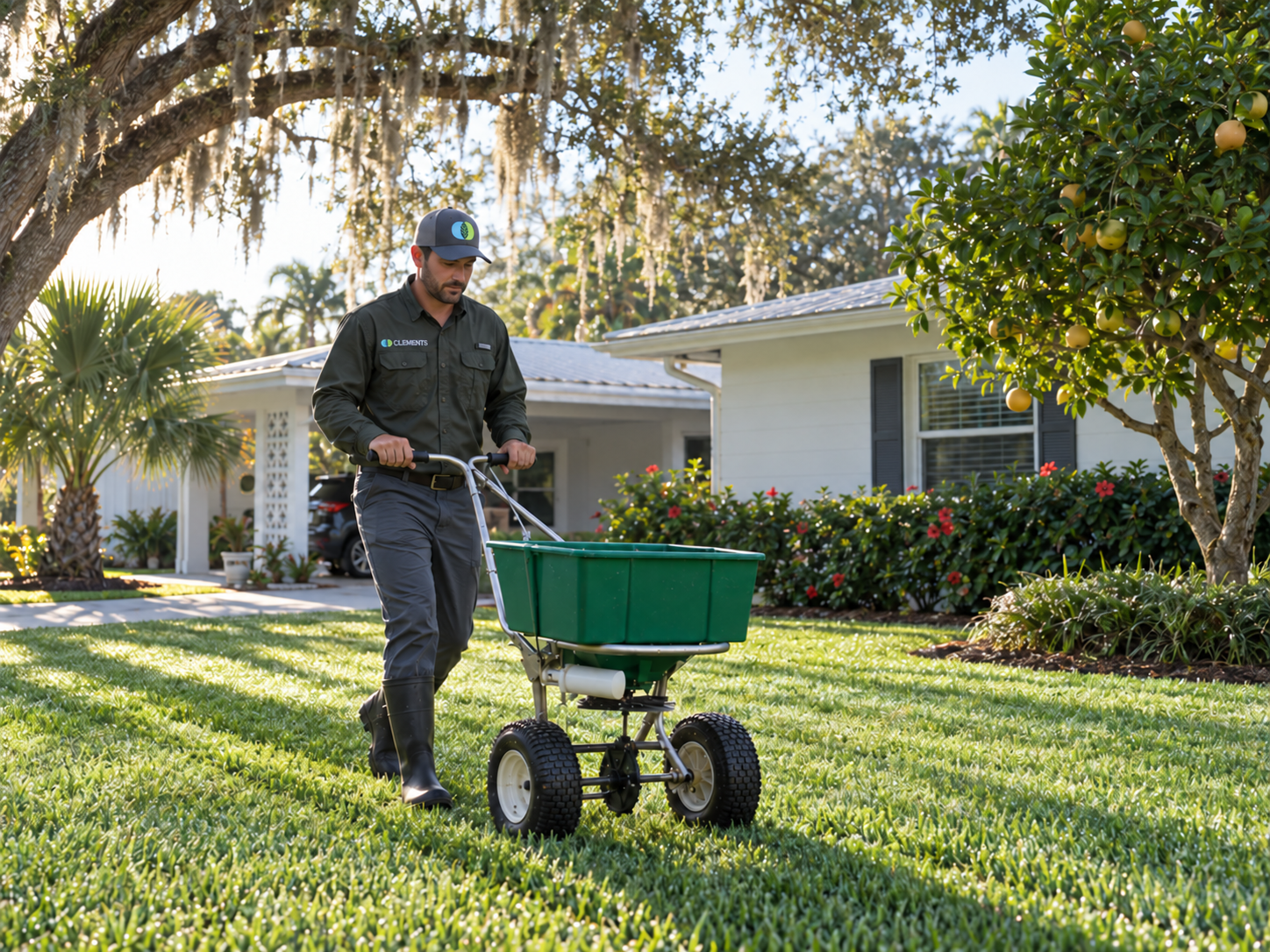
Fall fertilization is one of the few lawn tasks in Florida where the timing matters more than the effort. Put the right product down in the right window and the lawn goes into the cool season with good color and a root system that can handle it. Put the wrong product down a few weeks too late and you can create problems that will not show up until spring, when you are wondering why the grass came back thin.
Here on the Treasure Coast there are two calendars to work around, and they do not leave much room.
Your Window Is Narrower Than You Think
The first calendar is the county's. Indian River County runs a fertilizer blackout from June 1 through September 30, when applying fertilizer containing nitrogen or phosphorus is prohibited. That restriction exists because our rainy season washes nutrients into the stormwater system, and the stormwater system drains into the Indian River Lagoon. So no fertilizer went down legally during the summer growing months.
The second calendar is agronomic. UF/IFAS guidance on fall fertilization is clear that there is a point past which you should stop: the last recommended nitrogen application is September in North Florida and October in Central Florida. South Florida is a different situation, because lawns there often keep growing through the winter and may still use nutrients.
Line those two up and you get the picture. The blackout lifts September 30, the agronomic window closes around the end of October, and that is essentially your fall fertilization season. Mid-October is right in the middle of it.
Vero Beach Sits Exactly on the Line
Here is a detail that explains why fertilizer advice around here so often seems to contradict itself.
UF/IFAS divides Florida into three fertilization regions, and the published boundary between Central and South Florida is a line running coast to coast through Tampa and Vero Beach. Not near Vero Beach. Through it.
That is not a trivia point, it is a practical one. It means Vero Beach homeowners sit at the exact spot where two sets of recommendations meet, which is why one neighbor reads that the window closes in October and another reads that South Florida lawns can be fertilized into winter, and both of them are reading correct information.
It also means the annual nitrogen budget shifts depending on which side of the guidance your lawn actually behaves like. For St. Augustinegrass, UF/IFAS puts Central Florida at 2 to 3 pounds of nitrogen per 1,000 square feet per year and South Florida at 2 to 4. Zoysiagrass runs 1 to 2 in Central Florida and 1 to 3 in South Florida. Bahiagrass runs 1 to 3 in Central and 1 to 2 in South.
The way to resolve it is to stop reading the calendar and start reading the lawn. If the grass is still putting out new growth and you are still mowing on a regular schedule, it can use what you give it. If growth has clearly slowed and you have stretched the mowing interval out, it cannot, and anything you apply is going to leach rather than feed. That test works regardless of which line on a map your house falls on.
Skip the Bag That Says Winterizer
This is the most common and most expensive fall lawn mistake in Florida, and it is entirely the product of national retail.
Winterizer fertilizer is a northern concept. It exists for cool-season grasses like fescue and Kentucky bluegrass, which genuinely benefit from a late-season feeding. The products are typically heavy on nitrogen, something like a 27-3-3.
Our lawns are warm-season grasses, and they do the opposite thing in fall. St. Augustine, zoysia, and bahia are winding down. UF/IFAS is blunt about what a high-nitrogen application does at that point: it interferes with the dormancy process and forces the lawn to wake up and produce tender new growth at the wrong time of year. That tender growth is exactly what a cold snap damages, and the damage often does not become visible until spring.
So the bag is not merely unhelpful. It actively sets the lawn up to be hurt by the first real cold front.
What to use instead
If you are fertilizing late in the season, UF/IFAS recommends going low on nitrogen and high on potassium. Analyses like 9-2-24 or 5-2-14 are the shape of what you want, where the third number is doing most of the work.
Potassium is the nutrient that supports root development and general stress tolerance, including cold tolerance, without pushing top growth. That is precisely the trade you want heading into winter: strengthen what is below the surface, do not stimulate what is above it.
What the Rules Require in Indian River County
Beyond the blackout dates, the local ordinance carries a few requirements worth knowing, whether you are applying yourself or checking that your service is doing it right.
No phosphorus. Phosphorus-containing fertilizers are not permitted. Most soils in the county already carry enough phosphorus for turf, so additional applications largely end up as runoff.
At least 50 percent slow-release nitrogen. Slow-release sources feed the lawn gradually instead of dumping soluble nitrogen that a heavy rain can carry straight off the property.
A 10-foot buffer. Do not apply fertilizer within 10 feet of a wetland or water body.
Keep clippings out of the water. Grass clippings blown into storm drains, canals, or the lagoon are a nutrient source too. Blow them back onto the lawn.
The reasoning behind all of it is the lagoon. Excess nitrogen and phosphorus feed algae blooms, the blooms deplete oxygen, and the seagrass and marine life pay for it. For a community whose identity is tied to that water, this is one of the few lawn care topics where following the rules is the point rather than a formality.
Worth noting: local fertilizer ordinances get amended, and the requirements are not identical across every municipality in the county. If you are unsure what applies to your address, Indian River County can confirm it.
How Much Is Actually Right
The second most common mistake after the winterizer bag is treating fall fertilization as one big feeding.
The annual nitrogen numbers above are yearly totals meant to be divided across several applications, not applied at once. Separately, UF/IFAS guidance holds that no more than 0.7 pound of the nitrogen in any single application should be in soluble form, with slow-release making up the rest.
The practical version: a lighter, slow-release application that the grass can actually take up beats a heavy one that mostly ends up in the lagoon, and it beats it on lawn quality too, not just on environmental grounds.
Potassium is worth a soil test. An annual test is generally enough to determine what a lawn actually needs, and it takes the guesswork out of whether that high-potassium bag is solving a real deficiency.
Fall Is Large Patch Season, and Nitrogen Feeds It
This is the part that ties fertilization and disease together, and it is the strongest argument for going light.
Large patch is caused by Rhizoctonia solani, and it becomes active when temperatures drop below 80 degrees, generally from November through May. It is especially problematic in St. Augustinegrass and zoysiagrass, which covers most lawns in this area.
What it looks like: round discolored patches that widen over time, with darker or orange margins where the fungus is actively growing and brown, slightly sunken centers. The diagnostic check is to tug a few blades. If they pull away from the stems easily and the base is dark and smells of rot, that is large patch rather than drought stress or insect damage.
Excess nitrogen in fall makes it meaningfully worse. UF/IFAS recommendations for lawns prone to it are to apply only slow-release nitrogen and to apply it sparingly, and to irrigate only when necessary and always in the morning so the canopy is not sitting wet overnight. In South Florida, preventive fungicide timing generally falls around late October.
So the fall fertilization decision and the fall disease decision are the same decision. A heavy nitrogen application in October is not a neutral act on a St. Augustine lawn, it is fuel for the fungus that is about to become active. If you have had lawn fungus problems before, go lighter than you think you need to.
The Rest of the Fall Program
Fertilizer is one piece. A few others matter as much.
Raise the mower, or at least do not lower it. Keeping St. Augustine on the taller side going into the cool season supports deeper roots and shades out winter weeds. Scalping a lawn in fall is a reliable way to open it up to both.
Cut back the irrigation. Cooler temperatures and shorter days mean the lawn needs noticeably less water than it did in August. Most fall lawn problems in Florida involve too much water rather than too little, and overwatering is a direct contributor to large patch. Water in the morning, not the evening.
Handle winter weeds before they germinate. A pre-emergent applied as soil temperatures fall is far more effective than fighting annual bluegrass and other cool-season weeds after they are up. Timing is everything here, and the window is roughly the same one as fall fertilization.
Watch for sod webworms. They stay active into fall and can strip a lawn quickly. If you are seeing ragged, notched blades and patchy thinning, that is not a fertility problem and fertilizer will not fix it. It is worth learning to tell a stressed lawn from a pest-damaged one before you treat it, and fall armyworms are active in the same window.
Questions Vero Beach Homeowners Ask About Fall Fertilization
Can I fertilize my lawn right now in Indian River County?
In mid-October, yes. The county blackout runs June 1 through September 30, so the restriction has lifted. You are now in the window, and it is not a wide one, since UF/IFAS puts the last recommended nitrogen application for our region around the end of October.
Should I use a winterizer fertilizer?
No. Winterizer products are formulated for northern cool-season grasses and are typically high in nitrogen. On Florida warm-season lawns, UF/IFAS notes that a late high-nitrogen application interferes with dormancy and forces tender new growth that a cold snap will damage, often without the damage showing until spring. If you fertilize late, use a low-nitrogen, high-potassium product instead.
Is Vero Beach considered Central Florida or South Florida for lawn care?
Both, in a sense. UF/IFAS draws the dividing line between the Central and South Florida fertilization regions as a line running coast to coast through Tampa and Vero Beach, so we are literally on the boundary. That is why you will find conflicting advice locally. The reliable test is whether the lawn is still actively growing and being mowed on a regular schedule. If it is, it can use nutrients. If growth has slowed, hold off.
What happens if I miss the window entirely?
Nothing bad. Skip it and fertilize in spring when growth resumes. A missed fall application costs you far less than a poorly timed one, and there is no need to squeeze an application in during November to catch up.
Why is phosphorus not allowed?
Most soils in Indian River County already contain enough phosphorus to support turf, so added phosphorus tends to run off rather than get used. Once it reaches the lagoon it contributes to algae blooms. A soil test will tell you whether your lawn is an exception.
Will fertilizing now cause lawn fungus?
Over-fertilizing now can. Large patch becomes active as temperatures fall below 80 degrees and hits St. Augustine and zoysia hardest, and excess nitrogen makes it noticeably worse. Slow-release nitrogen applied sparingly, plus morning-only irrigation, is the combination that gets you good fall color without feeding the fungus.
Does my lawn actually go dormant here?
Partly. Growth slows considerably with cooler temperatures and shorter days, and you may see some color loss after a cold front, but Treasure Coast lawns generally do not go fully dormant the way North Florida lawns can. That slowdown is exactly why late-season nitrogen has nowhere useful to go.
Does any of this really affect the lagoon?
Yes, and it is the reason the ordinance exists. Nitrogen and phosphorus running off lawns during the rainy season feed the algae blooms that deplete oxygen and damage seagrass and marine life. Applying at the right time, at the right rate, in slow-release form, and keeping clippings out of storm drains are the parts of this a homeowner actually controls.
How Clements Pest Control Can Help
Fall fertilization is a case where getting it slightly wrong is worse than skipping it altogether. The product on the shelf is usually formulated for a different climate, the window is short, the county has requirements attached to it, and the same nitrogen that greens the lawn up also feeds the fungus that becomes active this time of year.
Our lawn care program handles the timing and the rate rather than leaving it to a bag and a guess: the right analysis for the season, slow-release nitrogen at appropriate rates, application that meets the county's requirements, and attention to large patch, sod webworms, and winter weeds while we are there. Clements has been taking care of Florida properties since 1961, and homeowners across Vero Beach and Indian River County rely on us for lawn care alongside pest control, termite protection, rodent control, and mosquito control. We also serve Stuart, Port St. Lucie, Orlando, and Naples.
If you would rather not work out which bag and which week, call us at 1-844-606-BUGS or contact Clements Pest Control and we will put your lawn on a schedule that fits the season and the rules.