
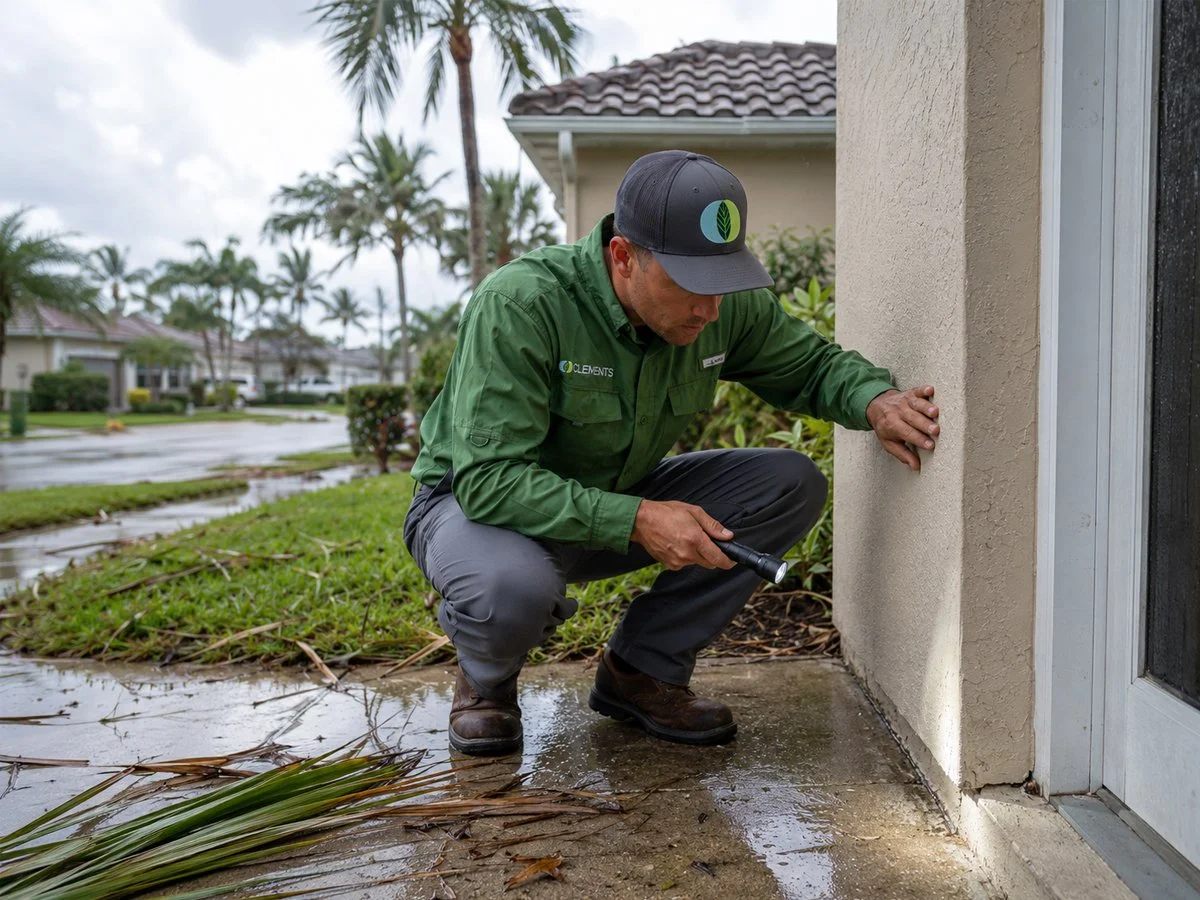
Pests move indoors after a Florida storm because flooding disrupts the soil, mulch, and debris where they normally live, while wind can open new gaps in the house itself. The activity tends to follow a general sequence: ants, roaches, and spiders can begin appearing within a day or two, mosquito pressure often becomes more noticeable about a week later, and rodent activity typically builds over the following weeks. Clements Pest Control inspects storm-affected homes across the Treasure Coast, Central Florida, and Southwest Florida, and can be reached at 772-562-6450.
Most homeowners are braced for the obvious storm damage. Shingles, fences, downed limbs, maybe some water intrusion. What catches people off guard is what happens over the next few weeks, when ants appear on the counter, roaches turn up in rooms that were always clean, and mosquitoes make the backyard unusable.
That delay is the useful part. Because the sequence is consistent, you can act during the window when it makes a difference instead of reacting after the problem has settled in.
Why Do Pests Come Inside After a Storm?
Pests come inside after a storm because the storm eliminates their outdoor habitat and simultaneously creates new ways into your house. Saturated soil floods ant colonies and rodent burrows. Wind strips away the mulch, leaf litter, and palm boots where roaches and spiders shelter. Standing water sits where it never sat before.
Meanwhile, your home is the driest, most stable structure on the property, and the storm may have opened new entry points by loosening flashing, warping a door frame, tearing a soffit, or ripping a screen.
Put those two facts together and the move indoors is close to inevitable. Pests are not targeting you. They are looking for the conditions they lost.
What Pests Show Up After a Florida Storm, and When?
Different pests respond on different schedules. Knowing the order tells you where to spend your effort.
The first day or two: ants, roaches, and spiders
Displaced insects tend to move first because they can. Flooded ant colonies often relocate as a group and follow foundation lines until they find a gap. Roaches pushed out of soaked mulch head for cover, and a dark garage or a warped door threshold works fine. Spiders tend to follow the insects.
If you are seeing a line of ants along a baseboard or roaches in the garage a couple of days after a storm, that is often displacement rather than an infestation you missed. It is also the easiest moment to address it, before anything settles in. Our pest control team can treat the exterior perimeter while the activity is still working its way in.
About a week later: mosquito activity climbs
Mosquito eggs laid earlier in the season hatch when floodwater reaches them, and container breeders take advantage of every saucer, tarp fold, and clogged gutter the storm filled. In Florida's summer heat, the egg-to-adult cycle can move quickly, often in the range of a week depending on temperature and conditions.
That lag is generally why a yard can feel fine right after the storm and much worse the following weekend. If mosquito pressure has already taken the yard back, mosquito control treatment targets both the adults and the places producing them.
Over the following weeks: rodents settle in
Rats and mice move more cautiously than insects, but flooding and debris removal disrupt their outdoor harborage and shift their food sources. Storm damage can open roof lines, vents, and utility penetrations that a rodent is able to use.
Scratching overhead at night, droppings along a wall in the garage, or gnaw marks on a soffit edge suggest something is already inside. Rodent issues tend to compound, so this is worth a prompt inspection rather than a wait-and-see. Our rodent control team handles storm-opened entry points and the activity that follows.
Months later: termites and wood-destroying insects
Storm damage that stays damp is a long-term invitation. Wet framing, leaking roof decking, saturated siding, and debris stacked against the foundation all create the soil-and-moisture conditions subterranean termites look for.
This one does not announce itself in a week. It shows up months later, which is why post-storm repairs deserve a closer look than most homes get. Our guide to summer termite season in Florida covers the six conditions that put a home at risk.
What Our Technicians See After Florida Storms
The pattern above is not theoretical. It is what our technicians run into on service calls in the days after heavy rain. A few things come up again and again.
Ants following foundation lines. Once the soil saturates, our techs frequently find trails running along the base of the slab, working toward the first gap they reach. Garage door corners, expansion joints, and the spot where a utility line enters the wall come up often.
Roaches moving out of saturated mulch and palm boots. Landscape beds that hold water push roaches toward the structure. Technicians commonly find heavy activity in mulch pressed against the foundation, under palm boots, and in leaf litter that collected against the house during the storm.
Entry points that were not there the week before. Damaged door sweeps, bent or torn screens, lifted soffit panels, and displaced vent covers show up on a large share of post-storm inspections. In many cases the homeowner had not noticed, because it is easy to look past when you are focused on the roof and the yard.
Materials left against the house after the storm. Sandbags still in place, stacked storm shutters, and debris piles waiting on pickup create harborage in exactly the spot you least want it.
Why Does a Clean Home Attract Pests After a Storm?
Cleanliness has very little to do with it. Even a home that has never had a pest issue becomes attractive after a storm, for three reasons that stack together.
Moisture changes everything. Damp drywall, wet insulation, a soaked crawl space, or a garage that took on water gives insects the indoor humidity they need, which is normally the one thing keeping them outside.
Access points multiply. Wind flexes a house. Weather stripping shifts, screens tear, soffit panels pull loose, and roof penetrations open slightly. Small changes, easy to miss, easy for pests to find.
Food handling gets sloppy, understandably. Power outages mean coolers, snacks left out, garbage that cannot go anywhere, and pet food scooped from a bag. A few days of that establishes an ant trail or draws roaches into a kitchen.
What Should I Do in the First Week After a Storm?
The window right after a storm is the most valuable one you have. A few focused hours now does more than weeks of treatment later.
Walk the perimeter before you start cleaning up
Before the debris moves, take a slow lap around the house and look at where the building meets the world. Check door sweeps, window screens, the gap where pipes and cables enter, dryer and attic vents, and the roof line for anything that shifted.
If you find gaps you are not sure how to close, or you would rather someone who does this daily look at it, we inspect and seal storm-opened entry points. Call 772-562-6450.
Drain everything that holds water
This is the highest-value hour you will spend, and it has to happen before day five. Empty and flip plant saucers, buckets, wheelbarrows, toys, and trash can lids. Flush clogged gutters, the most commonly missed breeding site on a Florida home. Drain tarps, pool covers, and boat covers. Rake out low spots holding water.
As a general rule, standing water left for several days can become a mosquito breeding site.
Handle debris piles carefully
Storm debris stacked against the house is a bridge, not just a mess. Keep piles well away from the foundation, get them hauled off promptly, and wear gloves. Wet leaf litter and palm fronds are full of roaches, spiders, and sometimes snakes. The same goes for firewood and leftover sandbags.
Dry out the inside
Run fans and dehumidifiers on anything that got wet, and do not assume carpet or baseboards dried on their own. Water that wicked into a wall cavity stays there. Persistent indoor humidity is what turns a temporary pest visit into a resident population.
Check the lawn
Storms leave turf bruised, flooded, and vulnerable. Standing water suffocates roots, and stressed grass is exactly what chinch bugs, armyworms, and fungus take advantage of. Once the water drains, watch for thin or discolored patches. Our breakdown on telling a stressed lawn from a pest-damaged one is worth having on hand.
When Is Post-Storm Pest Activity Too Big to Handle Yourself?
Some post-storm activity settles down once the yard dries out. Some does not. The dividing line is persistence. A few displaced insects passing through is normal. Activity that repeats on a schedule means something has established a place to live.
Call for help when you see:
Roaches during daylight hours, which can indicate a larger population or increased pressure pushing them out of hiding
Ant trails that return within days of being cleaned up
Droppings or gnaw marks in the attic, garage, or pantry
Mosquito pressure that makes the yard unusable two weeks after the rain
Wood that stayed wet and now shows blistering, soft spots, or mud tubing
Any one of those is worth having looked at. Inspections are straightforward, and we will tell you plainly whether what you found needs treatment. You can contact Clements Pest Control to set one up.
Common Questions About Post-Storm Pests in Florida
Why do I have bugs after a storm when my house is clean?
Cleanliness has almost nothing to do with it. Storms flood the soil, mulch, and debris where pests normally live, and wind opens small entry points on the house. The insects moving in are relocating out of necessity, not responding to anything happening inside your home.
How long does the post-storm pest surge last?
Insect activity often peaks in the first one to two weeks. Mosquito pressure tends to peak somewhere around one to three weeks out, and rodent activity can build over the first month. If your yard drains well and you seal the openings the storm created, most of it usually fades within a month. Standing water and damp building materials can extend it considerably.
Should I treat before or after a storm?
Both help, and they do different things. Treatment beforehand reduces the population that gets displaced. Follow-up afterward addresses what actually moved and the new conditions the storm left behind. If you can only do one, the follow-up usually matters more, because the storm changed the property.
Can storm damage lead to termites?
Yes, though not immediately. Termites are drawn to consistently damp wood and soil contact. Roof leaks, saturated siding, wet framing, and debris piled against the foundation create those conditions. Damage repaired and dried promptly is much lower risk than damage that sits for months. Homeowners wanting to avoid tenting should know no-tent termite treatment options exist in Florida.
Do I need to do anything different if I lost power?
Power outages mostly affect food handling and indoor humidity. Discard anything questionable from the fridge, keep coolers closed and clean, bag garbage tightly even if pickup is delayed, store pet food in sealed containers, and get air moving inside as soon as you can. Those few days are when most ant and roach problems start.
What if my neighborhood is still full of debris?
Pressure from surrounding properties is real and you cannot control it. Focus on what you can: keep your own drainage clear, seal your home's entry points, and consider an exterior perimeter treatment to create a barrier while the neighborhood catches up.
How much does a post-storm pest inspection cost?
Costs vary with property size and what needs to be inspected, so the honest answer is that it depends. Clements provides quotes before any work begins, and an initial inspection to identify what a storm changed is usually straightforward. Contact Clements Pest Control and we will walk through it with you.
How Clements Pest Control Can Help
Storm recovery is already a long list, and pest problems tend to surface right when you are stretched thinnest. The advantage of acting early is that post-storm pest pressure is predictable. It follows a pattern, and a plan built around that pattern is far easier than chasing problems room by room.
At Clements Pest Control, we help Florida homeowners handle the whole picture after a storm, from roaches, ants, and rodents to mosquito control, termite protection, and lawn recovery. Families across the Treasure Coast, Central Florida, and Southwest Florida count on us to inspect what the storm changed and close the gaps it opened, including homeowners in Vero Beach, Stuart, Port St. Lucie, Orlando, and Naples.
If a storm has left your home under pressure, call 772-562-6450 or contact Clements Pest Control to schedule an inspection.